Genesis Chapter 8: Analysis, Key Verses and Catholic Reflection
Genesis 8 sits at a pivotal moment in the Flood narrative: God’s mercy meets human fidelity as the waters subside and life on earth begins anew. Set within the broader framework of Genesis as a book of origins, this chapter foregrounds memory, providence, and covenant. Noah’s obedience and the resilience of creation unfold as the ark rests on the mountains of Ararat, and the post-flood sacrificial rite signals thanksgiving and renewal. In the NABRE, Gen 8 emphasizes divine remembrance, receding waters, a sign of peace through the dove, and the first explicit covenantal orientation toward a renewed relationship with creation.
Gen 8 continues the Flood narrative after the rain ends, detailing the ark’s resting place, the gradual reemergence of land, and Noah’s response to God’s mercy. The dialogue is largely narrative with direct divine speech converging in the concluding verses: God remembers Noah, signals an end to the flood, and lays the groundwork for a renewed creation through sacrifice and blessing. The setting remains within the ark, then shifts to the post-flood earth as Noah and his family begin to reinhabit. The chapter culminates in a sacramental moment (the altar) and a covenantal promise that will be elaborated in Gen 9.
Key Verses of Gen 8
Gen 8:1 — But God remembered
But God remembered Noah and all the beasts and all the cattle that were with him in the ark; and God caused a wind to pass over the earth, and the waters subsided.
Theologically, this verse roots salvation history in divine memory and mercy rather than in human effort alone. It signals a turning point: memory of Noah’s family and all living creatures initiates the process of restoration. The image of a wind passing over the earth foreshadows a new creation initiated by God’s initiative and faithful presence.
Gen 8:2 — The fountains of the deep and the windows of heaven
The fountains also of the deep and the windows of heaven were closed, and the rain from heaven was restrained.
This verse highlights God’s control over cosmic forces, illustrating that even the forces of chaos are subjected to divine order. The closure of the floodgates marks the beginning of restoration and the re-establishment of a stable creation. It also foreshadows the responsibility entrusted to Noah and his descendants to steward the earth responsibly.
Gen 8:6 — Forty days and forty nights
And it came to pass, at the end of forty days, that Noah opened the window of the ark which he had made.
The forty-day period here reinforces biblical motifs of testing and purification. Noah’s act of opening the ark’s window shows a disciplined move toward external signs of recovery. The verse also foregrounds human action within God’s salvific plan, inviting us to discern the proper response to God’s mercy.
Gen 8:8 — The dove is sent forth
And he sent forth a dove from him, to see whether the waters were abated from the face of the earth.
The dove serves as a sensible barometer of the earth’s healing. It introduces hope and the possibility of peace after turmoil. The scene anticipates a broader biblical pattern: signs that herald reconciliation and a fresh start for creation.
Gen 8:11 — Olive leaf in the dove’s beak
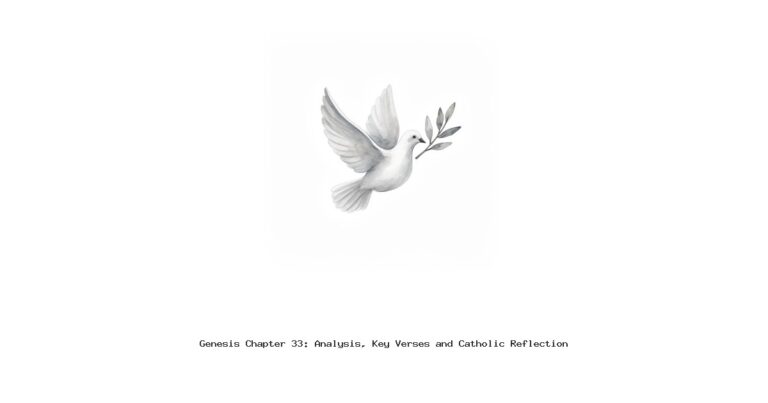
And the dove came in to him in the evening, and, lo, in her mouth was an olive leaf plucked off: so Noah knew that the waters were abated from the earth.
The olive leaf becomes a symbol of peace and renewal, reinforcing the theme of reconciliation between God and creation. This image invites readers to contemplate the inner life of the restored world—where life is possible again because God’s mercy endures. It also points forward to the covenantal order that will govern human beings’ relationship with the earth.
And the LORD smelled a sweet savor; and the LORD said in his heart, I will not again curse the ground any more for man’s sake.
This verse marks a catechesis on worship and divine satisfaction in human fidelity. Noah’s sacrifice becomes a pleasing offering that moves God to mercy rather than judgment. It also prefigures the more perfect sacrifice accomplished through Christ, wherein worship is united to the grace of salvation.
Gen 8:22 — The promise of stability
While the earth remaineth, seedtime and harvest, and cold and heat, and summer and winter, and day and night shall not cease.
The closing verse articulates a divine reality: creation is ordered and reliable so long as the earth endures. This endurance undergirds the liturgical calendar of God’s people—cycles of time that enable ongoing worship, work, and rest. It foreshadows a future that remains rooted in the Creator’s faithfulness and providence.
Church Teaching on This Passage
The Fathers and Magisterium read Gen 8 through a typological lens. The ark is often interpreted as a figure of the Church: salvation comes not by human merit but through participation in God’s saving action. Noah’s obedience, the dove’s sign, and the sacrifice point to deeper mysteries fulfilled in Christ. The chapter reinforces the universality of God’s mercy and the obligation of humanity to respond with reverence and gratitude, which culminates in the covenantal orientation for life together with creation. The Church also connects Noahic themes to the sacramental economy—particularly baptism as passing through waters into a renewed life, and the altar as a primitive form of liturgical worship anticipating the worship of the New Covenant.
This Chapter in the Liturgy
Gen 8 is not tied to a single fixed feast in the Roman Catholic liturgical calendar, but its themes appear in various readings throughout the liturgical year when the lectionary focuses on creation, the mercy of God, and the order of creation post-flood. The passage informs reflections on mercy, sacrifice, and divine fidelity, and it is often engaged in catechetical contexts about the meaning of the rainbow as a sign of God’s covenant ( Gen 9 ) and the continuity between the Old and New Covenants.
Verse for contemplation: Gen 8:1 — “But God remembered Noah and all the beasts…”
Meditation question: In what ways does God remembering Noah shape our understanding of divine faithfulness in the ordinary rhythms of life? How does memory cultivate gratitude and a mutual gift of blessing?
Prayer: Heavenly Father, stir in me a deep awareness of your steadfast mercy. Help me to respond with faith, gratitude, and generous stewardship of your creation. Through Christ our Lord. Amen.
FAQ about Genesis 8
1) Why does the chapter begin with God remembering Noah?
It underscores divine mercy and the personal care God extends to Noah and all living creatures, signaling the transition from judgment to restoration.
2) What is the significance of the dove and the olive leaf?
The dove and olive leaf symbolize peace, reconciliation, and the earth’s renewal; they foreshadow the broader peace God will establish with creation and point toward the covenantal order after the flood.
3) How does Gen 8 relate to baptism?
Many Church Fathers view the flood as a baptismal type: the waters signify cleansing, death to the old life, and rising to a revived creation under the grace of God.
4) Why is sacrifice present in Gen 8:20–22?
The altar and the aroma illustrate worship as response to divine mercy. It prefigures the ultimate sacrifice of Christ and the Church’s ongoing worship as gratitude for salvation.
Genesis 33 in NABRE: analysis of Jacob and Esau’s reconciliation, key verses with Catholic reflections, patristic insights, liturgical context, and a Lectio Divina.
A Catholic study of Genesis 34 (NABRE): text, context, key verses, church interpretation, liturgical use, and a short Lectio Divina reflection for prayer.