Genesis Chapter 48: Analysis, Key Verses and Catholic Reflection
Genesis 48 sits in the closing movement of Jacob’s life within the Book of Genesis, a section that frames the patriarchal narratives and the founding of Israel. In the NABRE, this chapter records Jacob’s final blessings and a striking act of adoption: Ephraim and Manasseh, Joseph’s two sons, are named as Jacob’s own heirs. Set in Egypt, the scene shows God’s fidelity at work in exile, reordering birthright and blessing and prefiguring the future of the tribes. The moment blends intimate family memory with deep theological meaning about providence, succession, and the ever-renewing covenant with the patriarchs and their descendants.
Gen 48 presents the moment when Joseph brings his two sons to his aging father in Egypt; Israel blesses them, adopts Ephraim and Manasseh as his own, and prophesies about their futures. The chapter is largely spoken by Jacob (Israel), with Joseph providing the context and presenting the grandsons. The setting is Goshen, during the last days of Jacob’s life as he blesses the younger generation and establishes the future of Israel’s tribes. The chapter foregrounds adoption, the transfer of blessing beyond the firstborn, and the steadfastness of God’s plan for the patriarchal line.
Key Verses of Gen 48
Gen 48:5 — Now your two sons, who were born to you in the land of Egypt before I came to you here, shall be mine;
Now your two sons, who were born to you in the land of Egypt before I came to you here, shall be mine; Ephraim and Manasseh shall be mine, as Reuben and Simeon are.
Theological explanation — Jacob’s explicit adoption of Ephraim and Manasseh signals a deliberate reorganization of tribal inheritance, independent of birth order. It demonstrates that divine promises and the future of the people rest in God’s initiative rather than human convention. This move foreshadows the later legal and prophetic patterns in Israel’s history where God’s choice shapes the identity of the tribes.
Gen 48:6 — But any children that they have after them shall be yours; they shall be called by the name of their brothers in their inheritance.
But any children that they have after them shall be yours; they shall be called by the name of their brothers in their inheritance.
Theological explanation — The verse clarifies that Ephraim and Manasseh’s future offspring belong to Joseph’s line, continuing the familial blessing while preserving the assimilation of these two lines into the broader Israelite inheritance. It underscores that blessings and inheritances in God’s plan are mediated through blessing and adoption, not merely through biological primacy. This anticipates the complex questions of lineage that will shape the tribes of Israel for generations.
Gen 48:9 — They are my sons, whom God has given me here.
They are my sons, whom God has given me here.
Theological explanation — Joseph presents his sons as gifts from God, highlighting God’s providential generosity. Jacob’s recognition that these children belong to the divine plan reinforces the sovereignty of God over human generations. The moment also deepens the father–son bond and confirms the legitimacy of Ephraim and Manasseh within Israel’s covenant family.
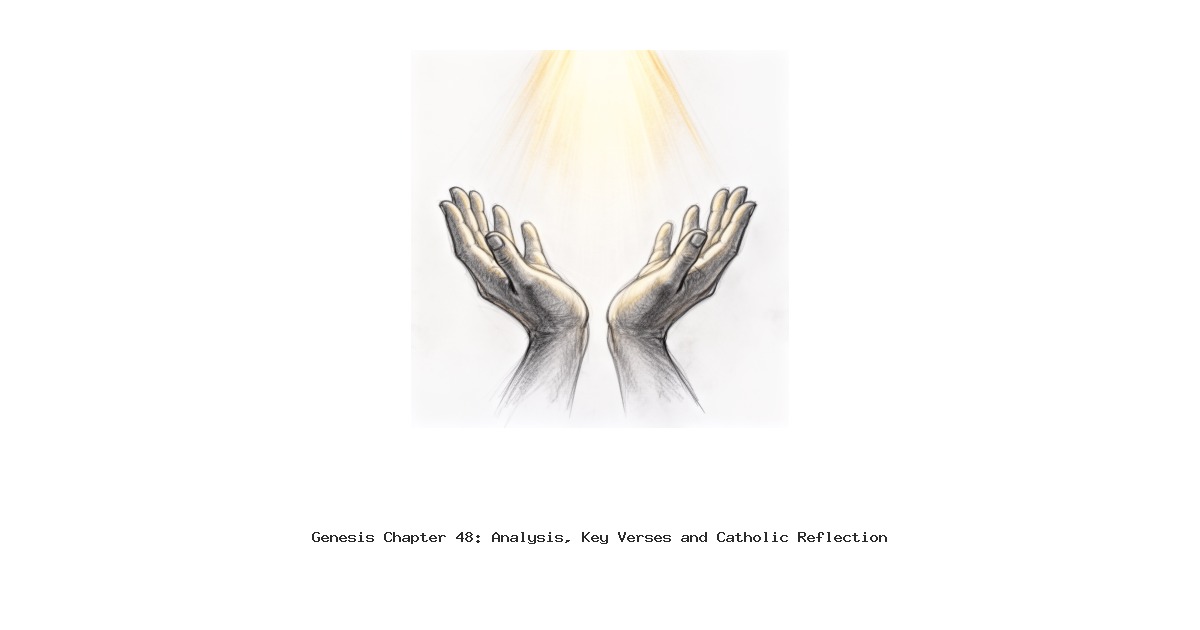
Gen 48:13 — Joseph placed Ephraim at his father’s right hand and Manasseh at his left, but Israel stretched out his right hand and laid it on Ephraim’s head, though Manasseh was the firstborn.
Joseph placed Ephraim at his father’s right hand and Manasseh at his left, but Israel stretched out his right hand and laid it on Ephraim’s head, though Manasseh was the firstborn.
Theological explanation — The crossing of Jacob’s hands is the central, dramatic act of the passage. It embodies God’s freedom to choose and bless beyond human expectations, signaling that the younger will sometimes receive the primacy of blessing over the elder. This gesture has become a canonical image of divine selection within the history of Israel and the Church’s reflection on grace.
Gen 48:14 — Israel stretched out his right hand and laid it on Ephraim’s head, though Manasseh was the firstborn.
But Israel stretched out his right hand and laid it on Ephraim’s head, though Manasseh was the firstborn.
Theological explanation — The deliberate blessing of Ephraim over Manasseh, despite the latter’s birth order, emphasizes God’s sovereign initiative in blessing. The act also foreshadows the future prominence of the tribe of Ephraim in Israel’s history and the prophetic pattern in which God’s promises fulfill themselves in surprising ways. The passage invites readers to trust that God’s plans surpass human calculation.
Gen 48:19 — But his younger brother shall be greater than he, and his descendants shall become a multitude of nations.
But his younger brother shall be greater than he, and his descendants shall become a multitude of nations.
Theological explanation — This is a powerful oracle about the destiny of Ephraim and Manasseh: the younger will have a greater spiritual and historical impact than the older. It reinforces the message that God’s blessings defy human expectation and that a nation’s future can be shaped by divine preference rather than mere birthright. The verse also foreshadows the broader role of Ephraim in prophetic symbolism within the Hebrew Bible.
Gen 48:20 — So he blessed them that day, saying, By you Israel shall bless, saying, God make you as Ephraim and as Manasseh.
Thus he blessed them that day, saying, By you Israel shall bless, saying, God make you as Ephraim and as Manasseh.
Theological explanation — This verse crystallizes a customary formula of blessing that would be used to invoke prosperity and divine favor upon future generations. It situates Ephraim and Manasseh as archetypes within the blessing of Israel, shaping liturgical memory and the practice of blessing within the community. The line also reflects how biblical authors understood blessing as a communal act with lasting, generational repercussions.
Gen 48:22 — And to you I give one portion more than your brothers, which I took away from the hand of the Amorite with my sword and with my bow.
And to you I give one portion more than your brothers, which I took away from the hand of the Amorite with my sword and with my bow.
Theological explanation — Jacob confirms a double portion for Joseph, underscoring the centrality of Joseph’s line within the broader narrative of Israel’s settlement and blessing. The explicit reference to a portion taken by conquest echoes the theme of divine providence through struggle and victory. This verse links past acts of divine intervention with the future distribution of land and blessing among the tribes.
In the Roman Catholic liturgical calendar, Gen 48 is not a fixed, stand-alone Sunday reading. When it is used liturgically, it tends to appear as part of the Joseph narrative or within weekday Mass readings and in the Liturgy of the Hours, where the Pentateuch’s patriarchal material is read in sequence. Its themes of blessing, adoption, and God’s sovereign choice are celebrated in Catholic prayer and preaching, even when the chapter does not occupy a regular spot in the Sunday Lectionary.
Lectio Divina
Verse for meditation: Gen 48:20
Thus he blessed them that day, saying, By you Israel shall bless, saying, God make you as Ephraim and as Manasseh.
Meditation question: How does Jacob’s blessing of Ephraim and Manasseh speak to your own family and community, where God’s grace may choose the unexpected rather than the expected?
Short prayer: Lord, grant me trust in Your providence and the grace to bless others with the same humility and faith with which Jacob blessed Ephraim and Manasseh. Amen.
FAQ
Why does Jacob adopt Ephraim and Manasseh instead of Reuben and Simeon for the blessing?
What is the significance of Jacob crossing his hands to bless the younger over the elder?
How does Gen 48 connect to the later biblical portrayal of the tribes of Ephraim and Manasseh?
What is meant by the “double portion” given to Joseph’s line in Gen 48:22?
Genesis 33 in NABRE: analysis of Jacob and Esau’s reconciliation, key verses with Catholic reflections, patristic insights, liturgical context, and a Lectio Divina.
A Catholic study of Genesis 34 (NABRE): text, context, key verses, church interpretation, liturgical use, and a short Lectio Divina reflection for prayer.