Luke 15 The Lost Son: Exploring the Prodigal Son Parable
Luke 15, frequently titled “The Prodigal Son” or “The Lost Son” in many Bible translations, is one of the most enduring parables in Christian storytelling. In Luke 15: The Lost Son, Jesus teaches about grace, forgiveness, and the surprising generosity of the Father through a narrative that centers on three lost things: a sheep, a coin, and a son. This long-form exploration looks at Luke 15 The Lost Son from multiple angles—its historical milieu, its literary design, its characters, and its ongoing relevance for individuals and communities today. By examining Luke 15 The Prodigal Son in depth, we can better appreciate why this Prodigal Son parable has resonated across centuries and cultures.
The setting of Luke 15 sits within the broader narrative of the Gospel according to Luke, where Jesus traveling among communities speaks in ways that ordinary listeners can grasp. In the world of the prodigal, a patriarchal household, property inheritance, and social expectations framed every decision. When the lost son asks for his share of the estate, he effectively wishes the father dead in order to receive his portion (a cultural signal that independence and wealth trump family ties in his mind). This moment is not merely about adolescence or rebellion; it reflects a social reality in which inheritance and honor carry weight. The parable’s premise—someone asks for freedom by severing ties—invites readers to contrast human impulse with divine mercy. In Luke 15 The Lost Son narrative, the audience is invited to notice how humiliation and restoration unfold in stages rather than as a single, dramatic reversal.
In addition to its Jewish-Greek context, this parable speaks to a broader audience within Luke’s Gospel. The surrounding chapters—especially the other two stories of loss in Luke 15 (the lost sheep and the lost coin)—frame salvation not as a solitary event but as a communal call to rejoice when the found return. When we encounter Luke 15 The Lost Son, we should keep in mind that the journey from estrangement to welcome is mirrored in other parables that celebrate a similar recovery of what was considered lost.
Narrative architecture: a trilogy of loss
The structure of the Prodigal Son parable within Luke 15 deliberately echoes the two preceding stories: the shepherd’s search for the one sheep and the woman’s search for the lost coin. Together, these tales communicate a single theological message—rejoicing in reconciliation when mercy breaks through human limitation. In Luke 15 The Lost Son, the narrative uses repetition, reversal, and symbolism to heighten its impact. The son’s request, the famine that drives him into hardship, the feast that heralds a new relation to the father, and the elder brother’s reaction—all function as a set of rhetorical devices to press home the central claim: God’s grace extends beyond conventional boundaries.
The Characters in Luke 15: The Lost Son, the Father, and the Elder Brother
The prodigal son: a journey from independence to dependence
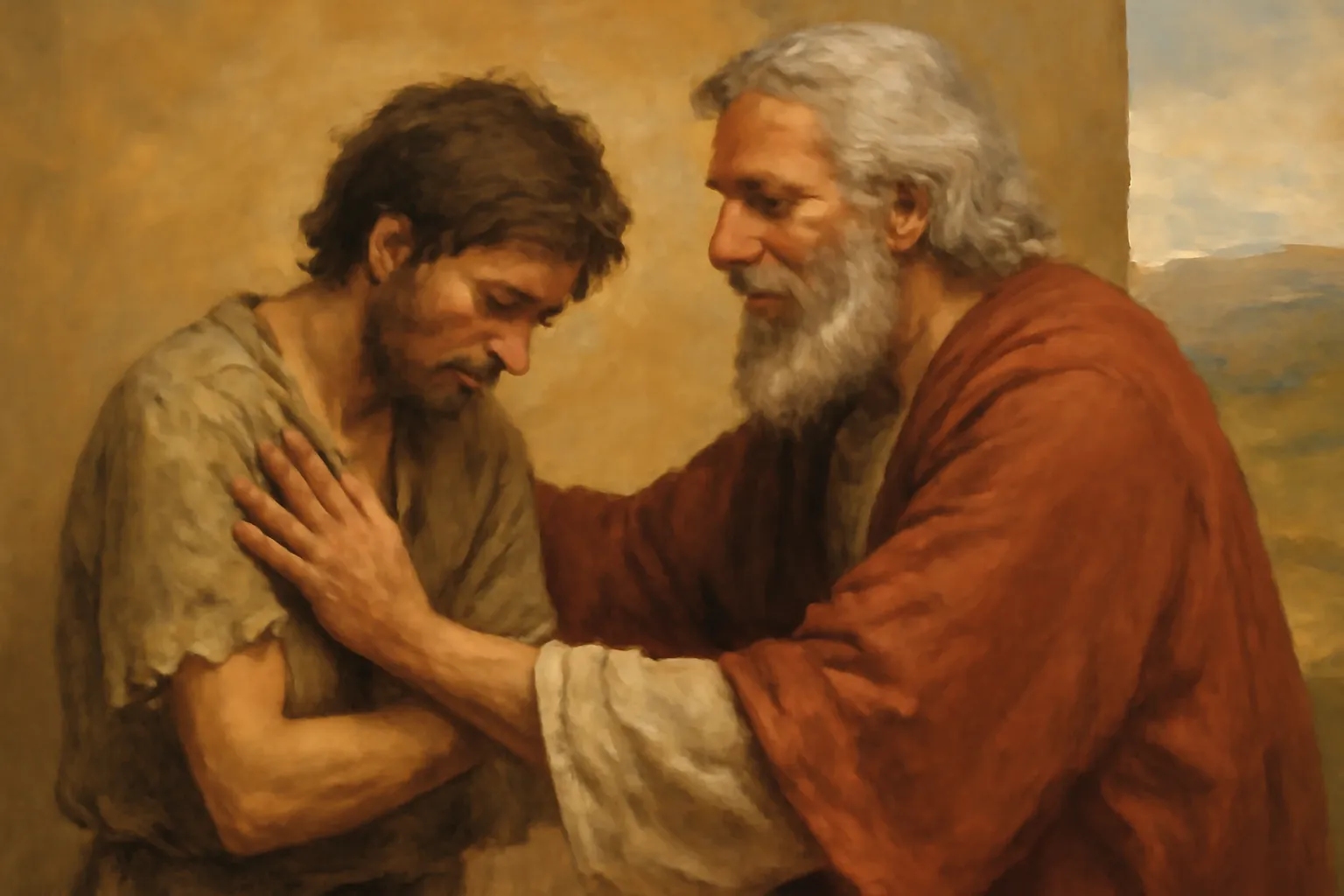
In Luke 15, the Prodigal Son begins with audacious self-determination. He asks for his share of the inheritance and then departs to a distant country where he squanders wealth on reckless living. The arc of the Lost Son is a study in self-justification, followed by stark reckoning. When famine strikes, his resources vanish, and he must confront the reality of his choices. The turning point in this Luke 15 The Lost Son narrative is not simply the moment of hunger; it is the moment of recognition—recognition that his only viable option is to return home and seek mercy, not compliance with a formal arrangement of forgiveness. The Prodigal Son’s return is a model of repentance that involves more than contrition—it requires an earnest desire to be reconciled to the family, to be seen as worthy not by status but by relationship.
The father: mercy, open arms, and transformative welcome
The father in Luke 15 The Prodigal Son is not a distant figure of restraint; he embodies unconditional love and forgiveness. His response to the prodigal’s return is remarkable: he runs to meet his son, orders the best robe to be brought, and commands the ring and sandals be given to the returning son. The fatted calf is slaughtered for a feast that signals reconciliation and communal reintegration. The father’s act challenges both social norms and personal pride, suggesting that grace often looks like hospitality extended to the undeserving. The story’s emphasis on a father’s extravagant welcome reframes forgiveness as a communal event that includes neighbors and observers who might question the legitimacy of such generosity.
The elder brother: boundary maintenance, resentment, and the challenge to grace
The elder son in Luke 15 The Lost Son often receives less attention than the prodigal, yet his role is essential. He embodies the mindset that righteousness is earned and boundaries are guarded. His complaint—“All these years I have been slaving for you, and never disobeyed your orders”—addresses a faith framed by law rather than grace. The elder brother’s refusal to join the feast highlights the tension between inclusion and exclusion. Through him, the parable asks readers to consider how communities respond when mercy is offered to those who have broken social expectations. The elder brother’s journey from self-righteousness to the needed humility of embracing grace becomes a crucial counterpoint to the prodigal’s return.
Key Themes in the Parable: Luke 15 The Lost Son and Beyond
One of the strongest themes in Luke 15 The Lost Son is the tension between grace and law. The younger son’s request for inheritance appears to be a breach of familial law and social expectation, yet the father’s response exceeds any legalistic remedy. The elder brother’s adherence to rules illustrates the other side of the spectrum—an emphasis on performance and status. The parable invites readers to consider how a community negotiates grace when rules collide with mercy. The message is not simply that grace exists; it is that grace disrupts predictable patterns of judgment and invites a redefinition of what counts as rightful belonging.
Repentance and restoration
Repentance in Luke 15 The Prodigal Son is not merely a feeling of remorse; it is a turning toward home and toward relationship. The prodigal’s decision to return to his father signals a relational restoration that surpasses economic or social restoration. The homecoming is not just about being fed; it is about being reintegrated into a familial and community plot of meaning. The narrative therefore reframes repentance as a path toward healing in which both the one who returns and the one who welcomes participate in a shared renewal.
The parable pushes readers to examine the boundaries of acceptance. The father’s hospitality toward the prodigal, and the implied invitation to the elder brother to join the feast, challenge readers to expand their sense of who belongs. Luke 15 The Lost Son uses the family as a microcosm of the kingdom of God, showing that inclusion is not merely a private sentiment but a public act of communal feeding, recognition, and shared joy. This theme resonates in contemporary discussions about social or religious barriers and who is invited to the center of community life.
Reversal of expectations
Across the parable, expectations are repeatedly upended. The younger son expects punishment but receives celebration; the elder son expects entitlement but receives an invitation to complicate his own assumptions about fairness. The narrative’s frequent reversals are designed to jolt listeners out of complacency and toward a more expansive vision of what it means to be found and to belong. The so-called Prodigal Son paradox—an extravagant welcome for those who squandered resources—becomes a moral invitation to examine how one’s own life might be transformed by encountering mercy.
The Prodigal Son in Theological and Literary Context
Luke 15 The Lost Son sits alongside two companion parables—the Lost Sheep and the Lost Coin—as a triad that celebrates divine initiative in seeking what is lost. In these parables, the search is not merely a narrative device; it is an icon of God’s initiative to reach beyond human boundaries to bring about reconciliation. The Prodigal Son thus becomes a culminating case study: if a shepherd and a woman will go to such lengths to recover what is lost, how much more will the Father in Luke’s story still pursue relationship with the rebellious and the righteous alike?
Scholarly discussions about Luke 15 frequently emphasize its use of imagery (robe, ring, sandals, fatted calf) as symbols of restored status and identity. The robe signals dignity; the ring signifies authority; sandals indicate a return to active family life; and the feast communicates communal acceptance. Taken together, these signs illustrate how identity formation is tied to being welcomed back into a shared table. The parable then invites readers to examine their own practices of hospitality, forgiveness, and inclusion.
Practical Implications for Today: Lessons from Luke 15 The Lost Son
Applying the prodigal narrative to personal life
Self-examination: The prodigal’s journey invites individuals to reflect on moments of independence that isolate them from relationships and community.
Humility and return: Return is not a sign of weakness but a courageous re-engagement with family, community, and faith commitments.
Grace over judgment: When others return, communities can choose hospitality over grudges, creating space for reconciliation rather than punishment.
Celebration of restoration: The communal feast symbolizes shared joy that accompanies reconciliation, not merely private forgiveness.
Applying the prodigal narrative to church and community life
Within a church or religious community, Luke 15 The Lost Son can serve as a corrective to rigid boundaries. It encourages leaders to foster environments where people can acknowledge past choices, seek grace, and re-enter communal life without being defined exclusively by past mistakes. It also challenges monastic or congregational cultures that equate righteousness with rule-keeping. When a community embraces the prodigal and extends a welcoming feast, it models the very justice and mercy that the parable emphasizes. This is why many readers refer to Luke 15 The Prodigal Son as a text about hospitality as a spiritual discipline—an ongoing practice of inviting others to belong at the table, regardless of their history.
Common Interpretations and Debates: Luke 15 The Lost Son in Contemporary Thought
Historical vs. literary readings
Some scholars emphasize the historical plausibility of the parable’s details, interpreting the drama in terms of first-century social norms. Others focus on the parabolic nature of the story, arguing that Jesus uses a fictional setup to convey a theological point about grace and forgiveness. Both approaches underscore that the Prodigal Son parable is less about a single historical incident and more about a fundamental truth about human relationship with the divine.
Ethical and pastoral debates
In pastoral settings, Luke 15 The Lost Son is sometimes used to address real-world issues such as reconciliation after conflict, the handling of forgiveness in families, and the role of leadership in promoting inclusive community life. Debates arise, for example, about how to balance accountability with mercy, or how to distinguish genuine repentance from strategic conformity. Proponents of extreme grace caution against enabling harmful behavior, while proponents of steadfast discipline warn against trivializing sin. The parable does not provide a single, simplistic solution; it invites ongoing discernment about when and how to welcome those who have harmed or betrayed trust.
Variations on the Theme: How the Lost Son is Read Across Traditions
Across Christian traditions and even beyond, readers refer to Luke 15 The Lost Son using several variations—Luke 15: The Prodigal Son, the Lost Son parable, or Luke 15 The Lost Son narrative. Each phrasing highlights a different facet of the same story: the prodigal’s wandering, the father’s forgiveness, or the broader message about restoration and communal life. Some sermons emphasize the younger son’s repentance; others highlight the father’s mercy; still others focus on the elder brother’s invitation to inclusion. By naming the passage in multiple ways, readers can emphasize different theological emphases while recognizing that the core message remains a profound invitation to encounter grace in everyday life.
Conclusion: Luke 15 The Lost Son as a Living Text
In sum, the parable commonly known as Luke 15 The Lost Son offers a rich tapestry of narrative artistry, theological depth, and practical guidance. Through the prodigal’s flight from home and his bitter yet hopeful return, the father’s lavish welcome, and the elder brother’s uneasy stance, this Prodigal Son parable challenges readers to rethink what it means to belong, to forgive, and to live in a community that embodies grace. Its enduring power lies in the way it reframes human failure not as an ending, but as an opportunity for reintegration, transformation, and renewed relationship. Whether read as a moral tale, a theological treatise on mercy, or a social critique of inclusion, Luke 15 The Lost Son remains a living text—one that continues to speak to those who seek to understand what it means to be found, to return home, and to feast together in a spirit of reconciliation.
For further reflection, consider revisiting the surrounding parables—the Lost Sheep and Lost Coin—to see how Luke constructs a cohesive message about joy in heaven when what is lost is found. And as you study Luke 15 The Prodigal Son, allow the symbols—the robe, the ring, the sandals, the feast—to guide your own contemplation of identity, belonging, and the invitation to participate in acts of mercy and compassion within your community.
What does it mean to be born again? The phrase born again isn’t merely a slogan or a religious cliché. In Christian teaching, it denotes a fundamental transformation that occurs when a person responds to God’s invitation to new life. In the pages of the New Testament, the language of...
Catholic scholarly analysis of Matthew 1 (NABRE): context, key verses, patristic teaching, liturgical use, and a meditative approach for personal reflection.
Catholic study of Luke 7 in NABRE: text and context, key verses with insights, Church teaching, liturgical use, Lectio Divina, and reflection and practice.
Luke Chapter 21 in NABRE: context, key verses, Catholic teaching, liturgical use, Lectio Divina, and practical reflection on watchfulness for Christ’s coming.