In a world where congregations increasingly gather from diverse linguistic and cultural backgrounds, churches are turning to multilingual worship technology to ensure that every member can participate meaningfully in services. Church translation devices, ranging from hardware-based simultaneous interpretation systems to modern app-driven delivery platforms, are not a luxury but a lifeline for inclusive worship. This guide explores the landscape of translation equipment used in churches, explains how the systems work, outlines their components, and offers practical guidance for selecting, installing, and operating the gear. While some churches need only a single language channel for a small chapel, others require robust, multi-language capabilities for large sanctuaries or campuses. Regardless of size, the right combination of devices can transform worship into a genuinely inclusive experience.
What Are Church Translation Devices?
At its core, a church translation device is any equipment, software, or combination thereof that enables real-time or near-real-time delivery of spoken or written content in multiple languages during worship. These systems enable interpreters, worship leaders, and technical teams to coordinate language delivery to listeners wearing personal receivers or using mobile apps. You may hear these terms used interchangeably: interpretation system, language delivery system, interpreting gear, or translation equipment. While the vocabulary varies, the goal remains the same: to deliver accurate, timely, and intelligible language in a way that preserves the liturgical flow and the warmth of the service.
Key distinctions to know
Simultaneous interpretation system (SIS): translators interpret in real time while the main service continues, and listeners hear the translated content through receivers.
Consecutive interpretation: a less common approach in worship settings, where the interpreter pauses after phrases to render the translation.
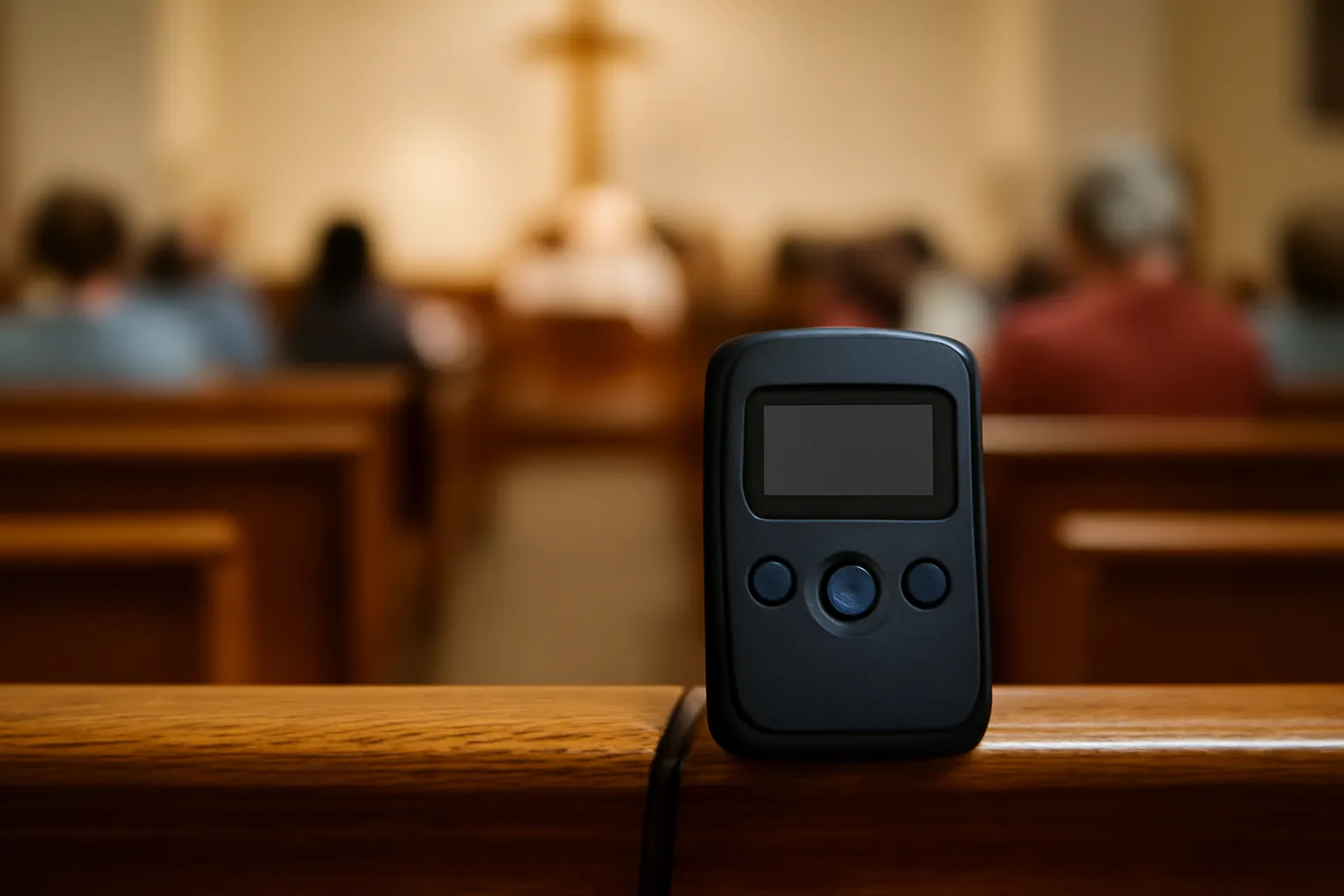
Personal receivers and headphones: handheld, belt-pack, or pocket devices that deliver language channels directly to listeners.
Translation console or interpreters’ desk: the control hub where interpreters listen to the source language and produce translation through a dedicated channel.
Infrared (IR), radio frequency (RF), and Wi‑Fi/network-based delivery methods: different technologies for delivering audio to listeners, each with strengths and trade-offs.
Core Components of a Translation System
A complete church translation system is more than a single device. The most effective setups interlock several components to create reliable, scalable language delivery. Here are the core components you’re likely to encounter.
Interpretation booth or interpreters’ workstation: a quiet space where translators can listen to the source language and deliver real-time interpretation. In very small venues, interpreters may work at a simple desk; in larger churches, a dedicated booth or control room helps reduce noise and improve concentration.
Translation console (also called an interpretation desk): the central control unit that distributes the source audio to interpreters, receives the translated audio, and routes it to language channels. Some consoles also manage mic inputs, cueing, and backup streams.
Microphone and audio input: high-quality microphones for interpreters, plus a clean feed from the worship team’s mics or the main soundboard to ensure accurate translation.
Language channels and channel labeling: the system assigns each language its own channel, which listeners select on their receivers or apps. Clear labeling reduces confusion during services.
Wireless transmission infrastructure: the method by which the translated feed travels from the booth to listeners. This can be infrared, RF, or network-based (Wi‑Fi) depending on venue size, building materials, and local regulations.
Personal receivers and headphones (or earpieces): devices worn by attendees that receive the chosen language channel. Receivers may be hand-held, belt-pack, or integrated with badges or smartphones.
Antenna distribution: for RF or IR systems, antennas must cover the service space. Proper distribution prevents dead zones and reduces interference.
Power and battery management: spare batteries, charging stations, and backup power plans to avoid service interruptions during worship.
Backups and redundancy: secondary feeds, alternative channels, and failover workflows that ensure continuity if one component fails.
Types of Translation Technologies
The technology choice depends on venue architecture, expected crowd size, languages offered, and budget. Here are the major delivery methods used by churches today, along with their typical advantages and limitations.
Infrared (IR) systems
IR systems use light-based signals transmitted from an infrared emitter to personal receivers. They are popular in smaller to mid-sized venues because they are relatively affordable and do not interfere with other RF devices inside the building. However, IR systems require line-of-sight to work reliably, and sunlight or bright room lighting can affect performance. Walls and furniture can also block the signal, creating blind spots. If you choose IR, plan for one emitter per space or zone and ensure the receivers have proper batteries and earphones. IR is generally a good fit for sanctuaries with controlled lighting and limited multi-building coverage needs.
Radio frequency (RF) systems
RF translation systems are robust and well-suited for larger spaces, multi-venue campuses, or facilities with multiple wings. They use licensed or unlicensed frequency bands to deliver language channels to wireless receivers. RF systems are less affected by walls than IR, but they can suffer from interference from other wireless devices. When deploying RF, churches typically consider FM-based or digital RF solutions. Digital RF often provides more channels, better audio quality, and easier integration with networked control systems. Regulatory compliance (local spectrum rules) and proper frequency coordination are essential to minimize cross-channel interference.
Wi‑Fi / network-based systems
A growing segment of church translation technology uses a cloud-enabled, Wi‑Fi or network-based delivery approach. Language streams are distributed over the church’s local network and may be consumed by mobile apps, web portals, or dedicated receivers that connect to the network. Benefits include easy scalability, flexible channel management, and potential cost savings on hardware. Challenges include network reliability, security concerns, and potential latency if the network is congested. For campuses with strong IT support, these systems offer excellent flexibility and future-proofing; for others, it may require careful planning and testing.
Hybrid systems
Some churches opt for a hybrid approach that combines IR or RF with network-delivered streams. A hybrid design can provide redundancy (e.g., IR primary, network backup) and allow attendees to choose from multiple delivery methods. Hybrid systems can enhance reliability, especially in venues with irregular construction or variable occupancy. They do, however, require careful coordination to ensure channel assignments and decoding rules remain consistent across delivery paths.
Choosing the Right System for Your Church
Selecting the best translation solution involves balancing needs, venue realities, and budget. The following guideline can help you narrow the options and design a system that serves your congregation today and adapts for the future.
Assess venue size and layout: small chapels may thrive with a single IR emitter and compact receivers; sanctuaries, multi-chapel campuses, or outdoor gatherings often require RF or network-based architectures with more channels and stronger coverage.
Determine language demand: how many languages will be offered now and in the near future? Plan for growth with modular expansion paths, so you’re not replacing systems in two years.
Consider acoustics and interference: reflective surfaces, noise levels, and nearby RF devices influence system choice. For spaces with complex acoustics, a high-quality interpreter microphone setup and good sound reinforcement are essential.
Evaluate audience access points: will attendees use personal receivers, church-issued devices, or mobile apps? A mix can work, but you’ll need clear instructions and consistent channel numbering.
Budget and total cost of ownership: consider hardware costs, installation, maintenance, training, batteries, and ongoing subscription or licensing fees for software components.
Redundancy and reliability: plan for backup language feeds, extra interpreters, spare receivers, and a documented troubleshooting workflow to minimize service disruption.
IT compatibility and security: if you pursue a network-based system, align with IT policies, use encrypted streams where possible, and ensure proper access controls for administrators and volunteers.
Training and staffing: interpreters require onboarding to the equipment and the church’s workflow. Include regular practice sessions and a quick-reference protocol for volunteers and staff.
Installation and Setup Considerations
A successful deployment hinges on thoughtful planning, testing, and clear roles. The following steps outline a practical path from planning to first service.
Map the space: create a floor plan identifying seating sections, balconies, and any areas that may harbor weak signal. Mark potential positions for IR emitters, RF antennas, and network access points.
Choose a primary delivery method: start with one reliable core system (e.g., RF for large rooms) and consider adding IR or network backup for flexibility.
Coordinate with the sound team: ensure the main sound system and the translation system share a clean feed, and establish gain structure so translations are not overwhelmed by stage audio.
Install interpreters’ equipment: place the interpretation booth or desk in a quiet location with a clear view of the stage, and set up microphones, headphones, and cueing controls.
Set up language channels: define language channels (e.g., English, Spanish, Portuguese, Mandarin), label them clearly, and assign each channel to a distinct feed on the console and receivers.
Position wireless infrastructure: install antennas or infrared emitters to maximize coverage while avoiding physical interference with seating and worship activities.
Test equipment individually: check each component—receivers, headsets, interpreters’ mics, and the console—before the service, and verify battery levels.
Run end-to-end tests: perform a full run-through with a volunteer panel representing a cross-section of the congregation to catch issues in real service conditions.
Prepare for contingencies: have a documented backup plan (e.g., a single-language fallback, a manual cue sheet for interpreters) in case of technical trouble.
Operational Best Practices
After installation, maintaining smooth operation requires consistent practice, clear communication, and proactive maintenance. Here are best practices used by churches that rely on translation equipment for ongoing worship services.
Regular training: provide initial training for interpreters, technicians, and volunteers, plus periodic refreshers to accommodate new team members or equipment upgrades.
Pre-service checks: run a pre-service checklist that covers battery levels, channel assignments, audio levels, and backup feeds. Timeliness reduces stress during service.
Clear signage and user guides: post simple instructions near receivers and on the church app, explaining how to select language channels and what to do if a device fails.
Battery and device management: establish a routine for charging, battery replacement, and storage of spare units so no attendee is left without a working device.
Quality control for interpretation: implement a feedback loop with interpreters—record and review translations for accuracy and style, and provide ongoing language support where needed.
Accessibility alignment: consider adding captions or transcript services for the deaf and hard of hearing, in addition to spoken-language translation, to broaden access to worship.
Security and privacy: ensure that any cloud-based components comply with church privacy policies, and manage user access to sensitive configuration data.
Common Pitfalls and Troubleshooting
Even with careful planning, issues can arise during services. Being prepared with practical solutions can save a service from disruption.
Interference and poor audio quality: recheck channel allocations, ensure antennas are properly positioned, and verify that receivers are tuned to the correct language channel. If interference is present, consider changing channels or switching delivery methods.
Dead zones or weak coverage: add another emitter or antenna, relocate a receiver to a more favorable spot, or adjust the layout to improve coverage.
Battery failures: carry spare batteries and schedule regular battery checks before services. Consider rechargeable packs with a quick-swap capability.
Latency or sync issues: network-based systems may experience latency if the network is congested. Prioritize traffic, upgrade network capacity, or switch to a more deterministic transport for critical feeds.
Speaker feedback or noise: ensure proper mic management, isolate interpreters’ microphones from main stage mics, and adjust EQ to minimize noise in translated channels.
User confusion: simplify language channel naming, provide on-site staff to assist attendees, and offer a brief orientation at the start of each service for new guests.
Case Scenarios: How Churches Use Translation Tech
Real-world deployments vary widely. Here are a few illustrative scenarios that show how different churches approach translation technology in practice.
Small chapel with one language aside from the majority: A single IR emitter and a handful of personal receivers may suffice. Interpreters work at a compact desk, and volunteers guide attendees to their channels before the service begins.
Medium-sized sanctuary with two active languages: A hybrid IR/RF setup with two language channels, plus a back-up network-based option for a third language if needed. This arrangement balances reliability with cost.
Large campus with multiple worship spaces: RF distribution across buildings, with central interpreters’ desk feeding multiple channels. An accompanying app provides either the same language channels or a supplementary captioning feature for accessibility.
Multi-service, multi-lingual offerings: A scalable system that supports weekend languages expanding from two to five. Modular hardware, software licenses, and staff training plans enable growth without a full system replacement.
Glossary of Common Terms
To help with planning conversations with vendors and IT teams, here is a concise glossary of terms you are likely to encounter.
Simultaneous interpretation
Real-time translation delivered concurrently with the source language.
Receiver
Portable device that plays the chosen language channel to the attendee.
Interpreters’ console
Control surface for translators to receive the source feed and output the translation.
Channel
A distinct language feed within the system.
Backhaul
The connection path from the source (microphones, sermon audio) to the translators and distribution network.
Latency
The delay between the original speech and the translated audio.
Future Trends in Worship Translation Technology
The field continues to evolve, driven by advances in audio engineering, wireless technology, and language AI. Here are some trends shaping the future of church translation devices.
AI-assisted real-time translation with qualified human oversight: AI can support interpreters by providing draft translations, glossary suggestions, and consistency checks, while human interpreters maintain accuracy and nuance, especially for religious terminology and liturgical phrasing.
Cloud-enabled scalability: cloud-hosted language models and distribution platforms can simplify upgrades, centralize management, and enable remote monitoring of system health across multiple spaces.
Accessible worship tools: live captioning, sign language support, and text-based feed options complement spoken translations, ensuring services meet diverse accessibility needs.
App-based experiences: mobile apps can deliver language channels directly to attendees’ smartphones, optionally with privacy controls and opt-in features to respect user preferences.
Hybrid resilience: increasingly, churches design systems with multi-modal redundancy to withstand outages in one delivery path while keeping the worship experience uninterrupted.
Maintenance and Upkeep: Keeping Translation Gear Ready
Like any technical system, translation gear benefits from proactive maintenance. Regular care extends device life, minimizes downtime, and protects your church’s investment.
Schedule routine inspections: quarterly checks of antennas, emitters, and receivers; verify firmware versions and compatibility across components.
Keep spares on hand: stock spare receivers, batteries, and cables to reduce service interruptions.
Document configurations: maintain an up-to-date log of channel assignments, interpreter rosters, and seating layouts for each service.
Test backups: periodically test backup language feeds and failover plans to ensure readiness.
Review vendor support: secure ongoing support agreements and access to firmware updates, spare parts, and remote diagnostics when possible.
Accessibility, Inclusion, and Community Impact
The purpose of translation technology in church settings goes beyond convenience. It is a deliberate step toward greater inclusion and belonging for parishioners who speak different languages or come from diverse cultural backgrounds. By investing in robust translation gear, churches demonstrate a commitment to:
Language justice: offering services in multiple languages empowers families to participate fully in worship and church life.
Spiritual connection: accessible liturgy and sermons help attendees feel seen, heard, and engaged, which can strengthen community bonds.
Global-minded worship: multilingual services can reflect international congregations, mission partnerships, and diaspora communities connected to the church.
Educational and outreach opportunities: translation capabilities support mission education, youth programs, and cross-cultural learning experiences inside and outside the church walls.
Getting Started: Practical Steps for Churches New to Translation Tech
If your church is considering a foray into translation devices, here is a practical checklist to help you begin with confidence.
Define goals: determine which languages to support, desired service formats (live translation, bilingual readings, captions), and audience size.
Set a budget: allocate funds for equipment, installation, training, and ongoing maintenance. Include a contingency for future expansion.
Consult stakeholders: gather input from pastors, musicians, worship leaders, the communications team, IT staff, interpreters, and potential attendees to understand needs and expectations.
Request demonstrations: invite reputable vendors to demonstrate IR, RF, and network-based systems in spaces similar to your church, noting ease of use and sound quality.
Plan for space and acoustics: work with an acoustician or audio consultant to optimize speaker placement, sound reinforcement, and the translation feed’s clarity.
Develop a rollout plan: start with a pilot service, then scale to additional languages or spaces over time. Build training into the rollout schedule.
Communicate with the congregation: provide clear guidance about how to access language channels, what devices are available, and how attendees can contribute feedback.
Conclusion
Church translation devices are more than a technical upgrade; they are a strategic investment in inclusion, community, and access. As worship practices evolve, a thoughtful approach to translation technology—one that balances reliability, scalability, and user experience—empowers churches to welcome more voices into the congregation. Whether you opt for a low-cost infrared system for a small chapel, a rugged RF deployment for a sprawling campus, or a network-based solution that leverages modern devices, the aim remains consistent: to deliver clear, accurate, and compassionate language support that honors and enhances every worshipper’s experience. With careful planning, thoughtful setup, and a commitment to ongoing stewardship of the equipment, multilingual worship can become a natural and enduring part of your church’s life.