Isaiah Chapter 50: Analysis, Key Verses and Catholic Reflection
Isaiah presents a vast collection of prophetic oracles addressing Judah during the exile and the return. In the latter portion of Isaiah, often called Deutero-Isaiah (chs. 40–55), the tone shifts to consolation, trust, and the hope of salvation grounded in God’s faithfulness. Chapter 50 belongs to the so-called Servant Songs, voiced by the Servant of the Lord who embodies fidelity under trial. The speaker declares a vocation of teaching and comforting, even while facing oppression. The passage, set in the context of exile, invites readers to trust in the Lord’s help and to imitate the Servant’s obedient stance, foretelling the Messiah’s suffering in light of God’s plan of salvation.
In this compact, striking chapter the speaker is the Servant of the Lord. The Servant asserts a divine vocation to speak and to endure, even under affliction. The Lord opens the Servant’s ear and equips him with the tongue to comfort the weary, while the Servant remains faithful rather than rebellious. He recounts his acceptance of suffering—back given to those who strike, cheeks to those who pluck, face not hidden from insult and spitting. The setting is the Babylonian exile and its aftermath, with a message of fidelity that anticipates God’s vindication and the restoration promised to Zion. The chapter thus bridges the cry of the faithful in exile with the hope of eventual deliverance and grace.
Key Verses of Isa 50
Isa 50:4 — The tongue of the learned
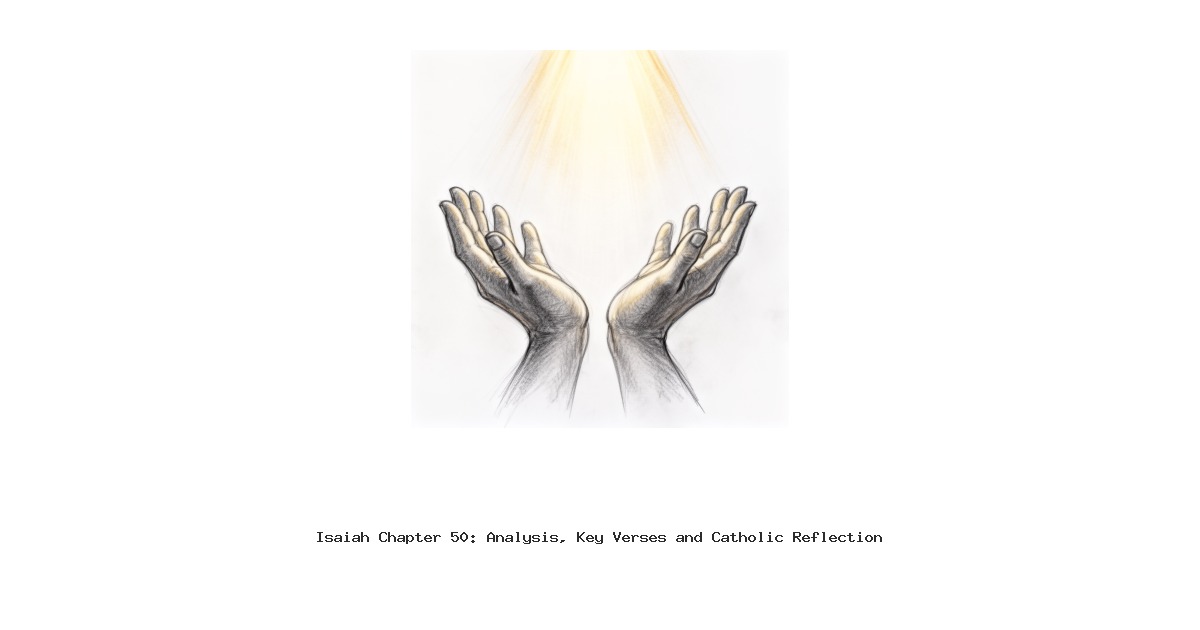
The Lord GOD has given me the tongue of the learned, that I may know how to speak a word in season to the weary; morning by morning he wakes my ear to hear, as one who is taught.
The verse frames the Servant’s vocation as a messenger of timely consolation rooted in divine instruction. It highlights a dependence on God to sustain the weary with a word that speaks truth and hope. It also foreshadows the ministry of Jesus, whose teaching and proclamation of the kingdom come from a Spirit-guided word in season for those in need.
The Lord GOD has opened my ear, and I was not rebellious, I did not turn back.
This line emphasizes obediential conduct and receptivity: the Servant heeds the Father’s will rather than resisting. It foregrounds an interior trust that allows the Servant to endure what follows. For Catholic interpretation, it prefigures the obedience of Christ and the sanctifying ignorance of worldly fear in the face of shame or suffering.
Isa 50:6 — I gave my back to those who struck me
I gave my back to those who struck me, and my cheeks to those who plucked out my beard; I did not hide my face from insult and spitting.
This is a powerful portrait of patient, voluntary suffering. It points to a foreshadowing of the Passion of Christ, where Jesus endures beating, humiliation, and crucifixion with steadfastness. It also calls the faithful to courage in the face of insult, trusting in God’s justice and mercy.
Isa 50:7 — The Lord GOD helps me
The Lord GOD helps me, therefore I am not disgraced; therefore I have set my face like flint, and I know I shall not be put to shame.
The Servant’s confidence rests in God’s help. The image of setting the face like flint conveys unwavering resolve to fulfill God’s mission. This verse reaffirms that fidelity to God even in danger brings ultimate vindication, aligning with the Catholic sense of divine faithfulness in suffering.
Isa 50:8 — He is near who upholds my right
He is near who upholds my right; who will contend with me? Let him come near to me.
The Servant declares that the one who defends him is near, inviting opponents to prepare for judgment. The text grounds hope in divine vindication and frames suffering as under God’s sovereign plan. In Catholic exegesis, this reinforces trust in God as judge and protector even amid opposition.
It is the Lord GOD who helps me; who will condemn me? They will all wear out like a garment; the moth will eat them.
This verse proclaims ultimate divine support and invites courage before accusers. It also presents the fate of oppressors as transient, contrasted with the enduring faithfulness of God. Christ’s Passion is understood as the fulfillment of this confidence in God’s protective help.
Church Teaching on This Passage
The Church Fathers repeatedly read Isaiah 50 as part of the prophetic witness fulfilled in Christ. The Servant Songs are viewed as foreshadowing the Passion and Resurrection, with Augustine and Jerome among those who highlight the Servant’s obedience and endurance as prefiguring Jesus. The Magisterium consistently treats Isaiah 50 as a scriptural revelation of the suffering Servant who trusts in the Father and bears witness to salvation, a figure that simultaneously points to Israel’s fidelity and to the Messiah in whom that fidelity finds its fullness. The passage teaches that God can work through weakness and suffering to accomplish salvation and reveal his steadfast love.
This Chapter in the Liturgy
Within the Roman Rite, the Servant songs, including Isa 50, are not standard Sunday readings but are valued for their Christological depth in the Liturgy of the Hours and in devotional use. They are often reflected upon during Lent and Advent as windows into the mystery of the Messiah’s suffering and the faithful endurance required of God’s people. The text serves to deepen contemplation of Jesus’ passion and our call to trust in God in times of trial.
Verse for reflection: The Lord GOD has given me the tongue of the learned, that I may know how to speak a word in season to the weary; morning by morning he wakes my ear to hear, as one who is taught.
Meditation question: In what situations today do you need to hear and speak a word of consolation to the weary around you?
Prayer: Lord, grant me the tongue of the learned and an open ear so that I may comfort the weary with truth and love. Make me faithful to your guidance each morning. Amen.
FAQ
Who is the speaker in Isa 50? The speaker is the Servant of the Lord, a figure who embodies fidelity under trial. In Christian interpretation, the Servant ultimately points to Christ, while in some readings it can also symbolize faithful Israel as a people.
What is distinctive about Isa 50 among the Servant Songs? Isa 50 emphasizes voluntary obedience and patient suffering as the Servant relies on God for vindication, highlighting a conscious, self-offering stance that prefigures the Passion.
Does Isa 50 predict Jesus? Yes. The passage is read in the Catholic tradition as a prefiguration of Christ’s suffering, death, and vindication, aligning with the New Testament portrayal of Jesus as the Suffering Servant.
How should Catholics interpret Isa 50 today? Catholics are invited to imitate the Servant’s trust in God amid suffering, to comfort others with words shaped by divine wisdom, and to see Christ’s fulfillment of the Servant’s mission as the source of salvation.