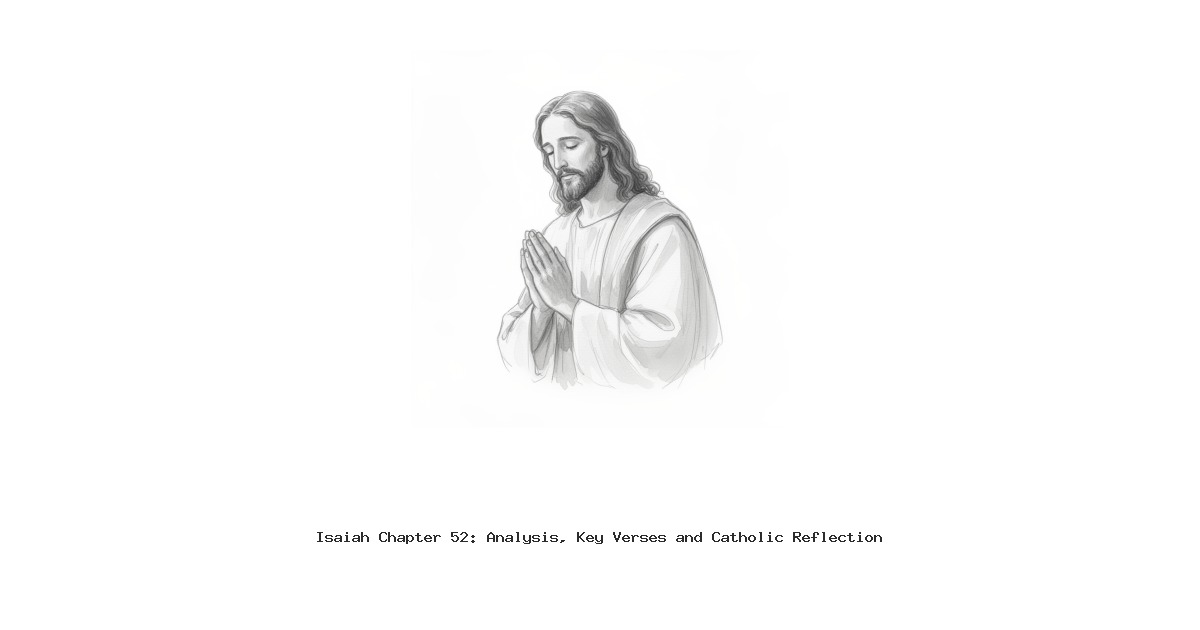
Isaiah Chapter 52: Analysis, Key Verses and Catholic Reflection
Isaiah 52 belongs to the second major division of Isaiah (Chs. 40–55), often called Deutero-Isaiah, written during the Babylonian exile to comfort God’s people and renew hope in His fidelity. This chapter marks a hinge from judgment to blessing: Zion is urged to awake, clothe herself in strength, and prepare for restoration, while the arm of the Lord is revealed to all nations. It also introduces the enigmatic Servant figure, who will prosper and be exalted after suffering, setting the stage for the famed Servant Song of Isaiah 53. For Catholics, Isa 52 invites trust in divine mercy and a missionary hope rooted in Christ.
Text and Context of Isa 52
The chapter continues the Deutero-Isaiah promise of liberation from exile and fulfillment of God’s covenant mercy. It begins with a call to Zion to rise and clothe herself in strength (52:1–2), signaling a refurbished people returning from exile. The passage then speaks of the Lord’s salvific arm revealed to the nations (52:7–10) and broadens into the remarkable portrait of the Servant who will prosper, be deformed in appearance, suffer for others, and yet bring universal salvation (52:11–52:15; culminating in the famous Servant Song of 53). The setting is cosmic and eschatological, pointing beyond the immediate return to a universal redemption fulfilled in Christ.
Key Verses of Isa 52
Isa 52:7 — How beautiful upon the mountains
NABRE excerpt: How beautiful upon the mountains are the feet of him who brings good news, who proclaims peace; who brings glad tidings of salvation, and says to Zion, Your God reigns!
The verse celebrates the messenger as a herald of peace and salvation, emphasizing the favorable response of the hearers to God’s saving work. It foreshadows the missionary mandate given by the Spirit to proclaim the gospel to all nations. In Catholic exegesis, it is often read as a prefiguration of the apostles and of the Church’s universal mission in Christ.
NABRE excerpt: The Lord has bared his holy arm in the sight of all the nations, and all the ends of the earth shall see the salvation of our God.
This verse personifies God’s saving activity as the revealing of His arm, a common biblical image for divine power exercised for deliverance. It underscores the universal scope of salvation, not limited to Israel but accessible to all peoples. In Catholic faith, it reinforces the truth that God’s plan of mercy extends to every nation through Christ’s saving work.
Isa 52:13 — Behold, my servant shall prosper
NABRE excerpt: Behold, my servant shall prosper, and he shall be exalted and lifted up, and shall be very high.
Here the Servant is introduced as one who will prosper and be exalted, yet the surrounding context foreshadows suffering. The juxtaposition of exaltation and affliction points to a paradox at the heart of salvation: greatness through obedience to God’s redemptive plan. Catholic interpretation sees this as a veiled reference to Christ, whose passion and cross lead to ultimate triumph.
Isa 52:14 — As many were astonished
NABRE excerpt: As many were astonished at you—his appearance was so marred, beyond human semblance, and his form beyond that of mortals.
The Servant’s appearance is marred to reveal a profound suffering endured for others. This verse explicitly anticipates the brutal physical toll of crucifixion-like imagery, which the New Testament later presents as fulfilled in Jesus. In Catholic theology, this passage is read as a prefiguration of Christ’s suffering and the redemptive value poured out through His wounds.
NABRE excerpt: So shall he sprinkle many nations; kings shall shut their mouths because of him; for that which has not been told them they shall see, and that which they have not heard they shall understand.
The concluding verse expresses the Servant’s mission to bring purification and blessing to many peoples, provoking astonishment even among rulers. The image of sprinkling conveys cleansing and blessing extended to Gentiles and nations beyond Israel. For Catholics, this verse affirms the universal call of the Gospel and the inclusion of all peoples in God’s saving plan through the Servant, i.e., Christ.
Church Teaching on This Passage
Catholic interpretation, as reflected in the Church Fathers and the Magisterium, has consistently read the Servant of the Lord in Isaiah 52–53 as a prophetic figure fulfilled in Jesus Christ. The Fathers, including Origen and Augustine, saw these passages as prefiguring the suffering, death, and ultimate glorification of Christ, and as illuminating the mystery of redemption through freely chosen obedience to the Father. The Catechism of the Catholic Church presents the Servant Songs as messianic prophecies fulfilled in Christ and connected to the mystery of the cross (cf. CCC 601–604, 613–614). The Magisterium reiterates that Isaiah’s Suffering Servant points to the crucified and risen Lord who gathers all nations into salvation.
This Chapter in the Liturgy
In Catholic liturgy, the Isaiah 52–53 material is associated with Advent and Holy Week. Passages such as 52:7 and the broader Servant Song motif are frequently proclaimed during Advent to anticipate the coming Messiah, while the explicit Servant–Suffering language of 52:13–53:12 is echoed in Holy Week readings that reflect on Christ’s passion, death, and redemptive glory. These readings invite the faithful to contemplate the mystery of salvation accomplished through suffering and to recognize the universal scope of God’s mercy in Christ.
Verse for contemplation: Isa 52:7 — “How beautiful upon the mountains are the feet of him who brings good news.”
Meditation question: How can I carry and share the good news of Christ in my daily life and relationships today?
Short prayer: Lord Jesus, give me the joy and courage to carry your good news to others, and to proclaim your peace in every corner of my world. Amen.
FAQ about Isaiah 52
Q: What is the central message of Isaiah 52 in Catholic interpretation?
A: It presents a hinge from judgment to mercy, introducing the Servant who will suffer and be exalted, foreshadowing the mission of Christ to bring salvation to all nations.
Q: Who is the “Servant” in Isaiah 52–53?
A: The Church has historically interpreted the Servant as a prophetic image fulfilled in Jesus Christ, though some texts may also reflect the collective obedience and suffering of the people of Israel in certain contexts.
Q: How does Isaiah 52 relate to Isaiah 53?
A: Isaiah 52:13–53:12 continues the Servant Theme, detailing the Servant’s suffering, death, and ultimate exaltation, which Christians understand as fulfilled in Christ’s Passion and Resurrection.
Q: Why is this chapter read in the liturgy and what themes does it emphasize?
A: Read during Advent and Holy Week, the chapter emphasizes anticipation of salvation, the universality of God’s mercy, and the paradox of exaltation through suffering found in Christ.