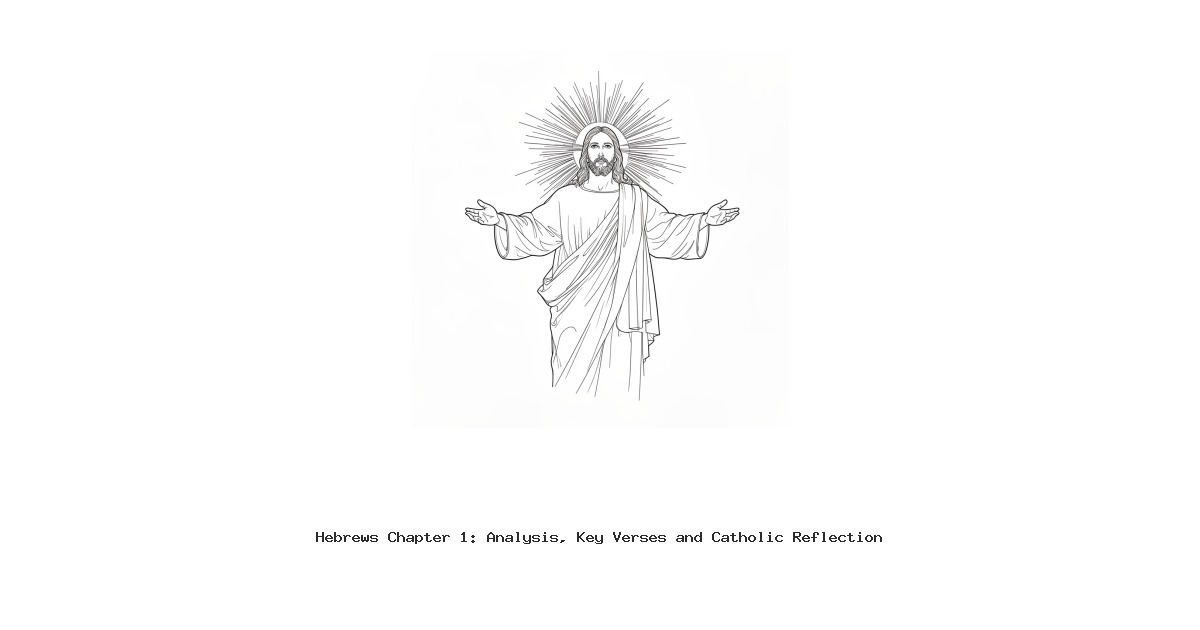
Hebrews is a Catholic New Testament letter addressed to Jewish Christians who faced pressure to revert to the Mosaic Law. Chapter 1 opens with an assertion that God has spoken through the Son, fulfilling and surpassing all prior revelation. The passage lays out a high Christology: the Son is the radiance of God’s glory, the exact representation of the divine being, the Creator through whom the universe was made, and the one who purifies sin and then sits at the right hand of the Majesty on high. The chapter blends cosmic vision with pastoral exhortation, inviting faithfulness to Christ as the decisive and final disclosure of God.
Text and Context of Heb 1
Summary of the chapter: The author addresses a Jewish-Christian audience, arguing that revelation reaches its fullness in the Son, who is the eternal image of the Father. God spoke in the past through the prophets, but in these last days he has spoken to us by his Son, through whom he made the world. The Son is described as the exact representation of God’s being, sustaining all things by his powerful word, and having offered purification for sins before taking his seat at the right hand of the Majest y on high. The chapter culminates in a claim of the Son’s superiority over angels and proper worship due to him as Lord.
Key Verses of Heb 1
Heb 1:1 — In times past God spoke
The NABRE text cannot be reproduced here; paraphrase: God spoke to our ancestors through the prophets in former times.
Theological explanation — The opening frames revelation as progressive, culminating in the person of Christ. It marks a shift from a prophetic to a revelatory mode centered on the Son. This sets up the argument that Christ reveals the Father in a more complete and definitive way.
Heb 1:2 — But in these last days he has spoken to us by his Son
Paraphrase: In these last days God has spoken to us by his Son, through whom he created the world.
Theological explanation — This verse locates Jesus in a decisive moment in salvation history. It identifies the Son as co-creator and heir, signaling that divine revelation now centers in him. The dauerhaft emphasis is that Jesus is the culmination of God’s communication with humanity.
Heb 1:3 — He is the radiance of the glory of God
"He is the radiance of the glory of God and the exact representation of his being."
Theological explanation — This verse presents Jesus as the visible manifestation of God’s inner reality. It asserts the Son’s ontological equality with the Father while underscoring his role in creation, sustenance, and purification. The language communicates both divinity and intimate unity with the Father.
Heb 1:4 — So he became as much superior to the angels
Paraphrase: Thus he is superior to the angels, and the name he has inherited is more excellent than theirs.
Theological explanation — The author contrasts the Son with angels to establish his unique status and authority. The argument uses scriptural quotation and typology to show Christ’s preeminence over all angelic beings. This supports the faith claim that worship belongs to Christ alone.
Heb 1:6 — And again when he brings the firstborn into the world
Paraphrase: When he brings the firstborn into the world, all God’s angels worship him.
Theological explanation — The “firstborn” motif signals Christ’s primacy in creation and salvation. The call for angels to worship him reinforces the Son’s supreme status and the proper order of creation under him. The verse uses Old Testament allusion to ground this claim in Scripture.
Heb 1:13-14 — To which of the angels has he ever said
Paraphrase: God has never said to angels that they should sit at his right hand; angels are ministering spirits sent to serve those who will inherit salvation.
Theological explanation — The closing lines reaffirm that angels are servants, not sovereigns, of the salvific work accomplished by the Son. The passage emphasizes the mission-oriented role of angels as ministers for the heirs of salvation. This underscores the distinctness of Christ’s divine lordship compared to angelic creatures.
Church Teaching on This Passage
From the patristic era to the present, Hebrews 1 has shaped Catholic teaching on the person and work of Christ. The Fathers, notably Origen and Chrysostom, emphasized the Son’s preeminence over angels and his participation in creation and redemption, illustrating Christ as the eternal Word who reveals the Father. Augustine and later scholastics integrated this Christology with the Trinitarian and soteriological frameworks of the Church. In the Magisterium, Hebrews 1 underlines the doctrine of Christ’s divine nature and the superiority of his priestly action, highlighted in the Catechism’s references to Jesus as the eternal Word and Creator through whom all things were made. The text continues to inform Catholic understanding of revelation through the Son and the fulfillment of God’s plan in the Incarnate Word.
This Chapter in the Liturgy
Hebrews is read in the liturgy at various times in the liturgical year, given its focus on the revelation in the Son and his dignity as Lord. It is particularly apt during Christological emphasis in Advent and Christmas seasons, when the Church proclaims the Word become flesh and the supremacy of Christ over all beings. The Epistle to the Hebrews also informs the faithful about perseverance in faith and trust in Christ as the definitive revelation and mediator of salvation.
Lectio Divina
One verse: Heb 1:3 — "He is the radiance of the glory of God and the exact representation of his being."
Meditation question: How does recognizing Jesus as the radiance of God’s glory shape my trust and response to God in daily life?
Prayer: Lord Jesus, reveal to me the truth of your glory and help me to reflect your light in my world today. May I fix my gaze on you, the exact imprint of the Father, and live in faithfulness to your word. Amen.
FAQ
What does Hebrews 1 teach about the relationship between Jesus and angels?
The chapter presents Jesus as superior to all angels, highlighting his unique status as the Son who bears the divine name and authority. Angels are depicted as ministering spirits serving those who will inherit salvation, not as rivals to Christ.
Who wrote Hebrews and to whom was it written?
The authorship of Hebrews is anonymous in the earliest manuscripts; the letter is addressed to a Jewish-Christian audience in the Mediterranean world, encouraging perseverance in faith in Christ rather than turning to old covenant observances.
How does Hebrews 1 relate to the Old Testament?
The author quotes and alludes to Old Testament themes to present the Son as the fulfillment and surpassing revelation of God, integrating creation language and divine kingship with scriptural precedent to ground Christology.
How can I apply Hebrews 1 in daily life?
By centering faith on Christ as the definitive Word of God, trusting his authority over other voices, and living in the awareness that God reveals himself most fully in Jesus. The chapter invites worship, obedience, and perseverance in faith, sustained by Christ’s priestly work and sovereignty.
Catholic NABRE study of Revelation 4: overview, paraphrased key verses, church teaching, liturgical use, Lectio Divina steps, and practical FAQs for reflection.
An in-depth Catholic study of Revelation 5 in NABRE, including text context, key verses with brief NABRE quotes, Church teaching, liturgical relevance, Lectio Divina, and practical reflections.