Job Chapter 19: Analysis, Key Verses and Catholic Reflection
Introduction: The Book of Job stands among the Wisdom literature, probing the mystery of human suffering, divine justice, and faithful response. In Job 19, the sufferer Job speaks directly to his friends and to God, turning his personal pain into a bold confession of faith. He defends his integrity, rebukes the false judgments of his companions, and holds fast to a living hope that transcends present misery. Written in rich poetic language, this chapter foregrounds the tension between human understanding and divine mystery, while anchoring trust in a Redeemer who stands beyond death.
Job 19 is part of the second cycle of speeches in the dialogue with his friends. Job answers the accusations of his companions, lamenting his isolation, the bitterness of his trial, and the sense that God has hidden His face from him. Yet the chapter also marks a turning point where Job articulates a profound hope: that a Redeemer lives and that he will see God, even in the face of physical decay and earthly misfortune. The setting remains the land of Uz, with Job speaking in the midst of his suffering as he pleads for understanding and vindication from God.
Key Verses of Job 19
Job 19:23 — Oh that my words were written!
Oh that my words were written!
The verse expresses Job’s longing for his life story to be recorded, a desire for lasting testimony beyond his immediate suffering. It foreshadows a deeper conviction that follows: even an unjust path can be made legible by faithful memory and divine judgment.
Job 19:24 — That with an iron pen and lead they were engraven in rock forever
That with an iron pen and lead they were engraven in rock forever.
This line underscores Job’s wish for permanent, indelible testimony to his words and experiences. The image of inscribing on rock conveys the seriousness with which he wants truth to endure, beyond the fleeting turmoil of life.
Job 19:25 — For I know that my Redeemer lives
For I know that my Redeemer lives
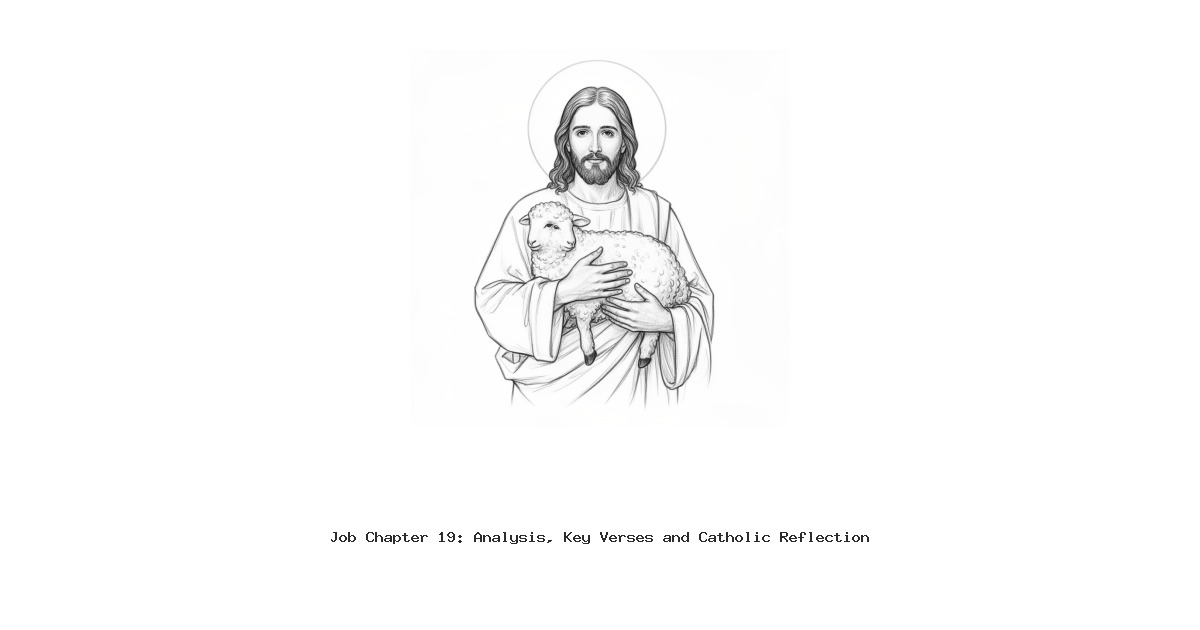
The heart of the passage, this declaration asserts a confident belief in a living Redeemer who stands in solidarity with the sufferer. It is a key Christological anticipation within the wisdom literature, later echoed in Christian faith as a testimony to the resurrection and divine justice.
Job 19:26 — And after my skin has been thus destroyed
And after my skin has been thus destroyed
This opening signals the paradox that physical ruin does not erase hope. Job envisages a future vindication in which he will see God in his flesh, pointing toward a deeper, eschatological restoration beyond death.
Job 19:27 — Whom I shall see for myself
Whom I shall see for myself
Job confirms his certainty of personal encounter with the divine; the future vision is experiential—his own eyes will behold God, not another. This personal witness strengthens the overall theme of trust amid suffering and anticipates the ultimate reversal of human fortune before the Creator.
Church Teaching on This Passage
The Church Fathers and later magisterial teaching regard Job 19:25–27 as a proto-Christological confession: a faithful antiquity that points to the coming Messiah and the resurrection. Early Christian writers such as Augustine highlight the refrain “my Redeemer lives” as an anticipatory confession of Christ’s victory over death, while maintaining the integrity of Job’s personal lament. The Church also sees in this chapter a model of steadfast faith under trial, reminding believers that suffering does not nullify God’s redemptive plan. In Catholic teaching, the text is read as a reminder that God’s justice and the final vindication belong to the unseen realm and are fulfilled in the risen Christ.
Job is not a fixed pericope in the standard Sunday lectionary of the Roman Rite. Nevertheless, Job 19 can appear in the Liturgy of the Hours or in occasional Bible readings within the Office of Readings, especially in seasons when Wisdom literature is highlighted (e.g., during Lent or Ordinary Time). Local liturgical calendars may vary, but the chapter is generally used to illuminate themes of suffering, faith, and hope in resurrection within Catholic worship and study.
Lectio Divina
Verse: Job 19:25 — For I know that my Redeemer lives.
Meditation question: What suffering in your life might you entrust to a living Redeemer, and how does that trust shape the way you endure today?
Prayer: God of steadfast love, help me to cling to the truth that you live and reign, even when I cannot see you. Increase my faith that I may encounter you in the depths of my pain and rise with the hope of your redemption. Amen.
FAQ about Job 19
What is the main message of Job 19? It is a plea for justice and a bold proclamation of faith in a living Redeemer who will vindicate Job, even after suffering physical decay and social isolation.
How does Job 19 relate to Christian belief? The profession “my Redeemer lives” is taken as a foreshadowing of Christ’s resurrection and ultimate victory over death, a theme echoed in Catholic tradition.
Why does Job wish his words were written or engraven on rock? It expresses a desire for durable testimony to the truth of his experience and the justice of God, even when present circumstances seem unjust.
Is Job 19 read in the Mass? It is not a standard Sunday reading in most cycles, but it may appear in the Liturgy of the Hours or as part of special biblical or catechetical liturgies that draw on Wisdom literature.
Catholic study of Prov 26 (NABRE): its context, key verses, patristic reflections, liturgical use, and a guided Lectio Divina reflection for study and prayer.
Explore Proverbs 28 in the NABRE: context, key verses, Catholic reflection, liturgical note, and Lectio Divina prompts on justice, integrity, and trust in God.