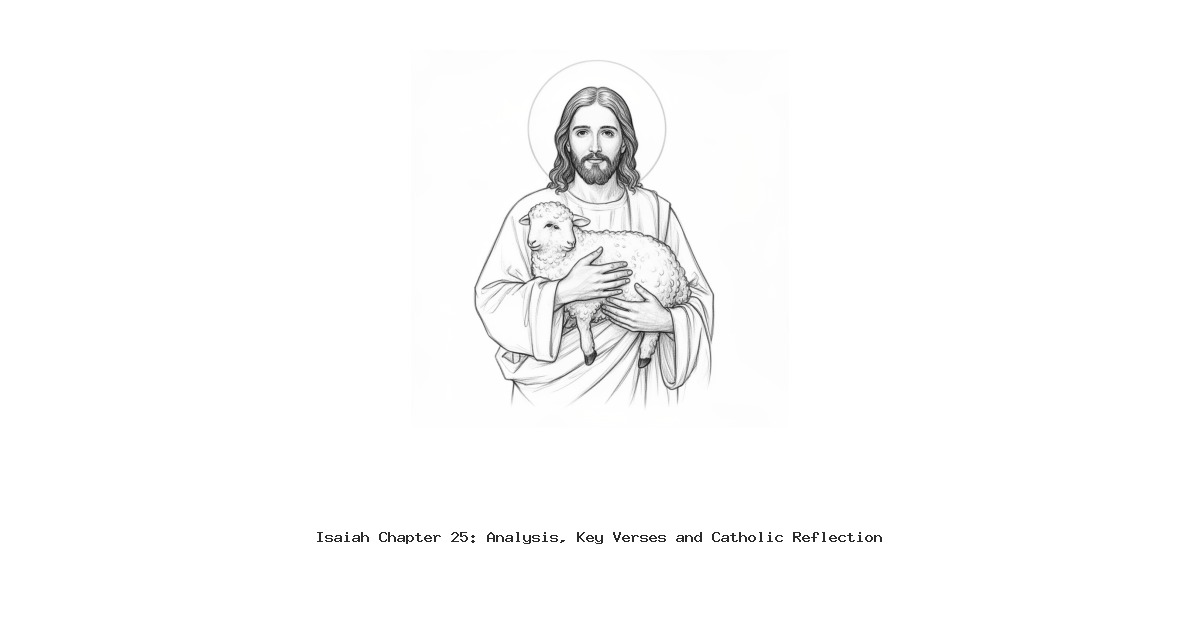
Isaiah 25 belongs to the Book of Isaiah, a central part of the Major Prophets. It forms a lyric of consolation and eschatological hope addressed to Zion and the people of Israel after exile and distress. This chapter presents a lyrical thanksgiving to the God who defeats death, removes disgrace, and invites all nations to his mountain for a feast of blessing. In NABRE, the text blends judgment and mercy, foregrounding the messianic age when sorrow ends and salvation is fulfilled. It invites readers today to trust in God’s promises and to anticipate the ultimate reconciliation of all creation in Christ.
Text and Context of Isa 25
Isaiah 25 is a short prophetic hymn, traditionally attributed to the prophet Isaiah, that expresses praise for God’s victory over hostile powers and death. The scene centers on ‘this mountain’—the Lord’s holy mountain—where a banquet is prepared for all peoples. The chapter moves from praise (25:1) to a banquet image (25:6), to removal of the veil and death (25:7–8), and finally a confident proclamation of salvation on that day (25:9). The speaker is the prophet with a chorus-like response from the people; the imagery points to the eschatological kingdom anticipated by the post-exilic community and by messianic expectation, fulfilled in Christ.
Key Verses of Isa 25
Isa 25:1 — O Lord, you are my God
O LORD, you are my God; I will exalt you, I will praise your name, for you have accomplished wonders, plans formed long ago, faithful and true.
The verse begins with a bold confession of faith and praise, anchoring the entire chapter in God’s steadfast faithfulness and plan. It sets a tone of worship in response to divine salvific action that transcends immediate political circumstances.
On this mountain the LORD of hosts will make for all peoples a feast of rich foods, a feast of well-aged wines, of rich foods filled with marrow, of aged wines well refined.
This verse envisions a lavish feast as a sign of God’s salvific rule. It foregrounds abundant grace offered to all peoples and foreshadows the messianic banquet in the eschaton.
Isa 25:7 — The veil is removed
And he will destroy on this mountain the veil that veils all peoples, the covering that is spread over all nations.
The imagery of removing the veil points to the unveiling of divine truth and the universal accessibility of salvation. It signals a transition from exile and concealment to radiant revelation in God’s presence.
Isa 25:8 — Death swallowed up forever
He will swallow up death forever, and the Lord GOD will wipe away the tears from all faces; the reproach of his people he will take away from the whole earth, for the LORD has spoken.
Central to Catholic eschatology, this verse proclaims the definitive defeat of death and the consolation of God’s people. It invites contemplation of the resurrection and the fullness of life in God’s kingdom.
Isa 25:9 — Behold, this is our God
It will be said on that day: Behold, this is our God; we have waited for him, that he might save us. This is the LORD for whom we have waited; let us rejoice and be glad in his salvation.
The response of faith and expectation is explicit here: the people recognize God’s saving presence and respond with joy. It ties the merciful acts of God to a communal act of worship.
Isa 25:10 — The hand of the LORD rests on this mountain
For on this mountain the hand of the LORD will rest; the LORD’s power and salvation are enacted in the sanctuary that stands as the seat of divine rule.
Closing the selection, this verse emphasizes God’s sustained care and the tangible presence of salvation on the sacred mountain. It points to the continuity of God’s saving work in the eschatological fulfillment.
Church Teaching on This Passage
The Fathers and later Magisterium read Isaiah 25:6–8 as a profound prophetic anticipation of the Messianic age in which Christ defeats death and gathers all peoples to God. Augustine and other Fathers highlight the banquet and the removal of the veil as symbols fulfilled in Jesus’ life, death, and resurrection, and as a foreshadowing of the heavenly banquet (cf. Catechism references on the resurrection and eschatology). The text is frequently cited in support of the Church’s teaching on eschatology, the resurrection of the body, and the universal scope of salvation in Christ.
This Chapter in the Liturgy
Isaiah 25:6–8 is used in the Catholic liturgy primarily as a prophetic foil for Advent and Christmas, presenting the coming Messiah as the giver of the divine feast and destroyer of death. The imagery of Mount Zion and the eschatological banquet aligns with Advent themes of hopeful waiting and the fulfillment of God’s promises. In the Liturgy of the Hours, these verses often appear in antiphons or biblical canticles associated with the Advent season and the Church’s eschatological hope.
Lectio Divina
Verse: Isa 25:6 — On this mountain the LORD of hosts will make for all peoples a feast of rich foods…
Meditation question: How does the image of a universal feast reveal God’s longing for all peoples to participate in his salvation?
Prayer: Lord Jesus, you are the host of the great feast; grant me openness to your grace, and make me a bearer of your mercy to others, until the day you renew all things in glory. Amen.
FAQ
1) What does the phrase “this mountain” refer to in Isa 25?
It is a symbolic reference to the Lord’s holy mountain (often identified with Zion/Jerusalem), where God makes his salvific presence known and where the eschatological banquet takes place.
2) Is Isa 25 only future prophecy, or does it have fulfillments in Christ?
In Catholic interpretation, it has both a historical sense for the post-exilic community and a fulfilled, fuller sense in Christ, who conquers death and gathers all peoples into the new covenant.
3) How does this relate to Jesus and the Resurrection?
Christ’s resurrection is viewed as the definitive fulfillment of the promise “death is swallowed up,” and the Church sees the heavenly banquet foreshadowed in the Eucharist and realized in the fullness of the Kingdom.
4) When was Isaiah 25 written and what is its literary context?
Scholars place Isaiah 25 within the larger prophetic corpus attributed to Isaiah of Jerusalem’s tradition, likely post-exilic (late 6th or 5th century BCE), as a poem of hope within the book’s sections of consolation and eschatology.