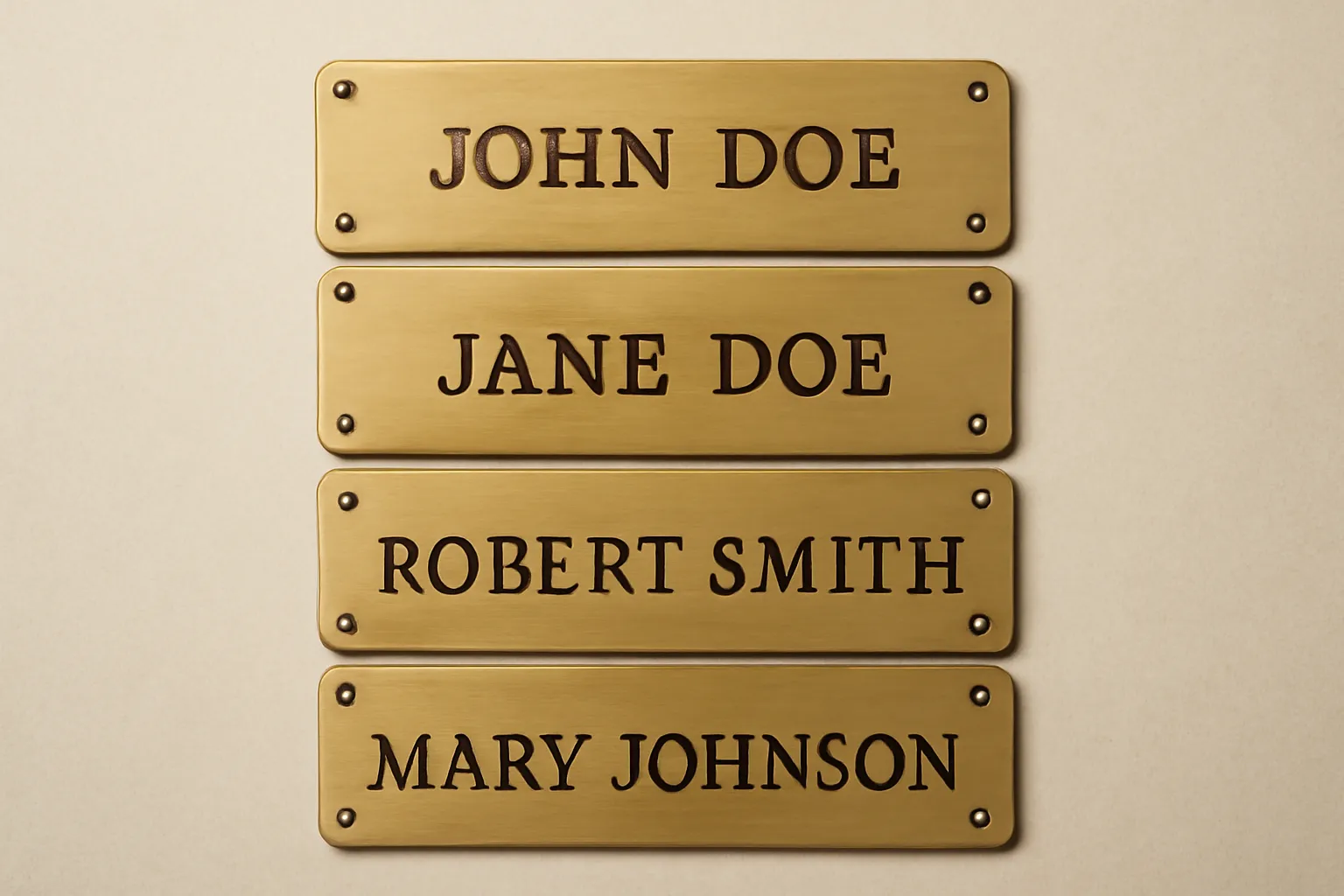
Brass Engraved Name Plates: Custom Metal Labels for Identity
In many environments, clear and durable identification is essential. Brass engraved name plates offer a timeless combination of readability, durability, and aesthetic appeal that makes them a staple in offices, laboratories, factories, hotels, and many other settings. Whether you call them brass name plates, engraved brass name plates, or engraved nameplates brass, these custom metal labels provide a reliable way to display names, roles, department designations, serial numbers, and other critical information. This article explores the world of brass engraved name plates, covering materials, engraving methods, design considerations, applications, maintenance, and practical guidance for choosing the right solution for your needs.
What are brass engraved name plates?
At their core, brass engraved name plates are small metal plaques made primarily from brass or brass-containing alloys. They bear text, symbols, or logos that are permanently inscribed through various engraving techniques. The result is a highly legible label that can withstand harsh environments, frequent handling, and long-term exposure to elements without sacrificing readability. The term encompasses a wide range of products, from simple door plaques for offices to sophisticated equipment labels used in industrial settings.
The material: brass properties, finishes, and why brass matters
Composition and durability
Brass is an alloy of copper and zinc that offers a balance of mechanical strength, machinability, and a warm, golden appearance. Brass plates are typically chosen for their corrosion resistance, ease of engraving, and a surface that accepts a wide variety of markings with high contrast. In many cases, brass is preferred over plain copper or aluminum because it scales well in thickness, resists denting, and maintains legibility even after years of exposure to dust, smoke, or fingerprints.
Finishes and patina
A critical design decision for brass name plates is the finish. Common options include:
Polished brass for a bright, reflective surface
Satin or brushed brass for a subdued, modern look
Antique or patinated brass to evoke a vintage feel
Lacquered brass to preserve color and reduce tarnish
Each finish has implications for readability and maintenance. For instance, lacquered brass can resist tarnish, but over time the finish may wear, requiring touch-ups. Antique finishes often rely on controlled patination to create darker recesses that improve contrast in text. When selecting a finish, consider the environment (indoor vs. outdoor, humidity, exposure to chemicals) and the desired aesthetic.
Protective coatings and compatibility
To extend life and preserve legibility, brass name plates may receive protective coatings. Common options include clear lacquer coatings, polyurethane, or specialized industrial sealants. It is important to ensure compatibility with engraving methods and the chosen ink or mark (if color-filled engraving is used). Coatings can also aid in anti-tarnish performance, reducing the frequency of maintenance.
Engraving methods: how text and imagery are applied
Mechanical engraving
Mechanical or traditional engraving uses a cutting tool to physically remove material from the brass surface. This method creates recessed channels that stock text (and sometimes logos) in relief. It is known for durability and a classic crisp edge. Mechanical engraving works well for high-contrast name plates where the engraved text remains legible even after years of abrasion.
Laser engraving
Laser engraving uses a focused laser beam to etch the brass surface. This creates precise lines and can handle intricate fonts, logos, and microtext that would be difficult with a handheld tool. Laser-engraved brass name plates can produce shallow marks suitable for filled colors or for subtle monochrome contrasts. Because laser engraving is non-contact, it reduces the risk of mechanical distortion on thin brass sheets.
Chemical etching and photochemical processes
For very fine detail or for color-filled effects, chemical etching or photochemical processes may be employed. In this approach, a resist is applied to the brass surface, areas are exposed to etchants, and the resulting trenches are then filled with ink or left as clean grooves. This method can produce exquisite typography and logos with delicate lines. It is especially popular for high-precision nameplate labels used in corporate branding or archival installations.
Cost and performance considerations
Generally speaking, engraved brass name plates produced by mechanical engraving tend to be more economical for high-volume orders, with strong durability. Laser engraving offers superior design flexibility and is ideal for small batches or highly detailed graphics. Chemical etching can achieve intricate artwork but may involve more complex lead times and handling of chemicals. When planning a project, weigh the desired level of detail, longevity, risk of wear, and cost per unit.
Design and layout: creating readable, effective brass name plates
Choosing fonts, sizes, and spacing
Readability is the cornerstone of any effective brass plate name. When selecting fonts, choose clean, sans-serif or humanist serif styles with ample letter spacing. For doorway plaques or equipment labels, a minimum font size of 8–10 points is common, with higher contrast between the text and background. For mult-line layouts, consider line breaks that group related information (for example, name on the top line, title or department on the second line, and a room or location code on the third).
Information to include
The content on a brass engraved name plate should be purposeful. Common elements include:
Name of the person or designation (e.g., Jane Doe or Maintenance Supervisor)
Title or department (e.g., Facilities)
Room or office number, extension, or location code
Company logo or emblem (subtle, if allowed by design)
Serial numbers or asset IDs for equipment labels
Layout examples and best practices
A well-designed brass name plate should balance aesthetics with legibility. Some best practices include:
Keep critical information on the top two lines for quick scanning
Use high-contrast engraving (e.g., darkened text in light-exposed grooves) if the finish supports it
Avoid overly long text blocks; opt for concise phrasing
Align text consistently with mounting holes or borders to create a neat, professional look
Customization options: making each label truly yours
Mounting and installation choices
The way a brass name plate is mounted can affect both usability and durability. Common options include:
Inset mounting with screws or rivets for doors and panels
Adhesive backing for temporary or tool-free installation on smooth surfaces
Magnetic mounting for equipment labels that need occasional repositioning
Stand-alone frames or displays for desk labels or trophy-like plaques
Edges, sizes, and shapes
Brass name plates come in a variety of shapes—rectangular, rounded, circular, or custom-cut to fit a specific space. Edge finishing, such as beveled, rounded, or squared edges, influences both aesthetics and durability. Typical sizes range from small 1″ x 3″ rectangles for office doors to larger 4″ x 6″ panels for equipment and control panels. Selecting the right size helps ensure legibility from the intended viewing distance.
Color, contrast, and text fill options
Color-filled engraving is a popular technique where the engraved grooves are filled with enamel or epoxy paint to enhance contrast. For example, avoiding light-on-dark color schemes that reduce legibility in bright ambient light is advisable in outdoor or warehouse environments. Some customers prefer a clean monochrome look with darkened engraving, while others opt for subtle color highlights that align with branding.
Applications and industries: where brass engraved name plates shine
Office doors and interior spaces
In commercial and institutional settings, brass name plates identify offices, conference rooms, and meeting spaces. For added professionalism, organizations often pair brass plaques with corresponding room signage and directory systems. The timeless sheen of brass complements a professional interior while remaining highly legible at a glance.
Facilities, labs, and manufacturing
In industrial environments, durable brass name plates help label equipment, control panels, and tool cribs. They can be attached to machinery housings, safety enclosures, or electrical cabinets. In laboratories, engraved brass labels may identify fume hoods, storage cabinets, or sample rooms, combining reliability with a clean, standardized appearance.
Hospitality and retail
Hotels, restaurants, and retail spaces use brass plate name solutions for staff directories, asset labeling, and wayfinding. The warm aesthetic of brass can convey a sense of craftsmanship and attention to detail that aligns with luxury or heritage branding.
Awards, honors, and commemoratives
Brass name plates also serve in commemoratives and awards programs. Engraved brass plaques can bear honorees’ names, dates, and logos, lasting as keepsakes with enduring legibility.
Durability, maintenance, and longevity
Resistance to wear and environmental factors
One of the core advantages of brass engraved name plates is their durability. Brass resists corrosion in many environments and maintains legibility through a combination of engraving depth and surface finish. For outdoor applications, consider powder-coated or lacquer-sealed finishes to minimize tarnish and reduce maintenance frequency.
Cleaning and care tips
Proper care helps preserve the appearance and readability of brass plates. Suggested practices include:
Dust with a soft microfiber cloth to prevent scratching
Avoid abrasive cleaners that could wear down engraving or finishes
Use a pH-neutral brass cleaner or a mild soap solution for routine cleaning
If tarnish appears, apply a specialized brass polish with a soft cloth, then re-apply any protective coating as needed
Re-engraving and replacement considerations
Over time, labels may require updates—whether to reflect a personnel change, department reorganization, or asset relocation. Brass engraved name plates can often be re-engraved or touched up without replacing the entire plaque. When including the option for future updates, planners may choose screw-monded plates for easy replacement of text panels or battery-backed color fills that can be refreshed without removing the entire plate.
Production process: from concept to finished brass name plate
Design proofs and client approvals
The process typically begins with a design brief. Customers submit text, logos, fonts, and finish preferences. A designer prepares mockups and proofs, ensuring legibility, contrast, and alignment with branding. Approval of proofs is critical to prevent costly revisions after production begins.
Material selection and fabrication
Once the design is approved, the brass sheet or plate is prepared. The chosen engraving method (mechanical, laser, or chemical) is applied, and any color fills or coatings are added. Precision tolerances are important to ensure mounting holes align correctly with door frames or equipment housings.
Quality control and final inspection
Before shipment, name plates undergo inspection for engraving clarity, finish consistency, and mounting hole placement. Checks may include:
Edge quality and corner radius
Engraving depth and legibility
Finish uniformity and color fill coverage
Adhesive backing perfection or screw-hole alignment for mounting
Lead times and budgeting
Production timelines depend on quantity, complexity, and finish. For bulk orders, brass plate name projects benefit from economies of scale, with per-unit costs decreasing as quantity rises. Begin planning several weeks in advance for complex logos, color fills, or custom shapes; smaller runs can often be delivered in days to a couple of weeks, depending on the supplier’s capacity.
Cost considerations: evaluating value, not just price
What drives the price
Several factors influence pricing for brass engraved name plates:
Material thickness and plate size
Engraving method (mechanical vs laser vs chemical etching)
Mounting hardware, backings, and installation services
Lead time and quantity
Value and long-term return
While brass name plates may carry a higher upfront cost than some plastic alternatives, they offer distinctive advantages: durability, legibility over years, and a premium appearance that can reinforce branding and professionalism. For organizations prioritizing asset tracking, security, and aesthetics, the total cost of ownership often favors brass across the product’s life cycle.
Installation and care: practical guidance for getting it right
Mounting tips for best results
Proper mounting is essential to ensure readability and longevity. Consider these tips:
Use appropriate hardware for the surface (wood, metal, or concrete) and climate conditions
Ensure the plate is level and aligned with surrounding signage
For adhesive-backed plates, clean the surface and allow the adhesive to cure fully before exposure to heavy use
If using screws, reserve a little extra clearance for future text changes or replacements
Maintenance cadence
Routine maintenance should be tailored to the environment. Indoor offices may require less frequent cleaning, while outdoor or high-humidity locations benefit from periodic inspection for tarnish or coating wear. Establish a simple maintenance schedule—quarterly or semi-annually—depending on traffic and exposure.
Environmental considerations and sustainability
Recyclability and lifecycle
Brass is highly recyclable, making brass name plates a sustainable choice when managed responsibly. Reclamation of brass scrap is common in manufacturing, and the plates themselves can be remanufactured or repurposed when replacements are needed. Choosing durable coatings that extend life reduces waste by postponing replacements.
Supplier responsibility and ethics
When possible, select suppliers with transparent sourcing practices and environmental policies. It is also beneficial to consider local manufacturing to reduce transportation emissions and support regional economies.
Alternatives to brass name plates: when brass is not the right fit
Other metals
If corrosion resistance, sterilization requirements, or magnetic properties are critical, alternatives like stainless steel name plates, bronze name plates, and aluminum name plates may be preferable. Each material offers distinct economics and aesthetics—stainless steel for industrial resilience, bronze for a classic look with slightly different patina, and aluminum for light weight and cost efficiency.
Plastic and composite options
For cost-sensitive projects or temporary labeling, high-quality plastics or composite materials can be effective. Modern plastics can mimic the appearance of metal with metal-like finishes and are easier to fabricate in very large quantities. However, they typically lack the long-term durability of brass in demanding environments.
Case studies and real-world scenarios
Case study: university research labs
A university department upgraded door plaques and lab equipment labels using engraved brass name plates. The project highlighted the durability required in high-traffic corridors, the need for color-filled branding on lab equipment, and the benefits of a unified signage system across facilities. Results included improved wayfinding, reduced mislabeling, and a more cohesive campus aesthetic.
Case study: luxury hotel brand
A boutique hotel selected brass name plates with antique finishes for door plaques, inlays on furniture signage, and commemorative plaques in the lobby. The decision balanced a premium aesthetic with the practical demands of high-occupancy environments. The result was a durable solution that reinforced brand identity through consistently styled signage.
Best practices: planning a brass name plate project
Define the scope: doors, rooms, equipment, or awards
Set readability targets: distance, font, and contrast
Choose a finish that complements the environment and branding
Decide on mounting or adhesive solutions based on surface and usage
Prepare for updates: consider modular designs or interchangeable text panels
Conclusion: why brass engraved name plates remain a trusted choice
Brass engraved name plates bring together durability, elegance, and legibility in a way few other labeling solutions can match. Their versatility spans simple office door plaques to complex industrial asset labels and commemorative plaques. By understanding the material properties, engraving methods, design considerations, and maintenance requirements, organizations can select the right brass name plates to meet functional needs while enhancing brand perception. Whether you opt for classic polished brass or a modern satin finish, the core strengths—clear identification, long-term readability, and a distinguished appearance—remain constant. In short, brass name plates are not merely labels; they are enduring identity markers that communicate professionalism, precision, and care for detail.