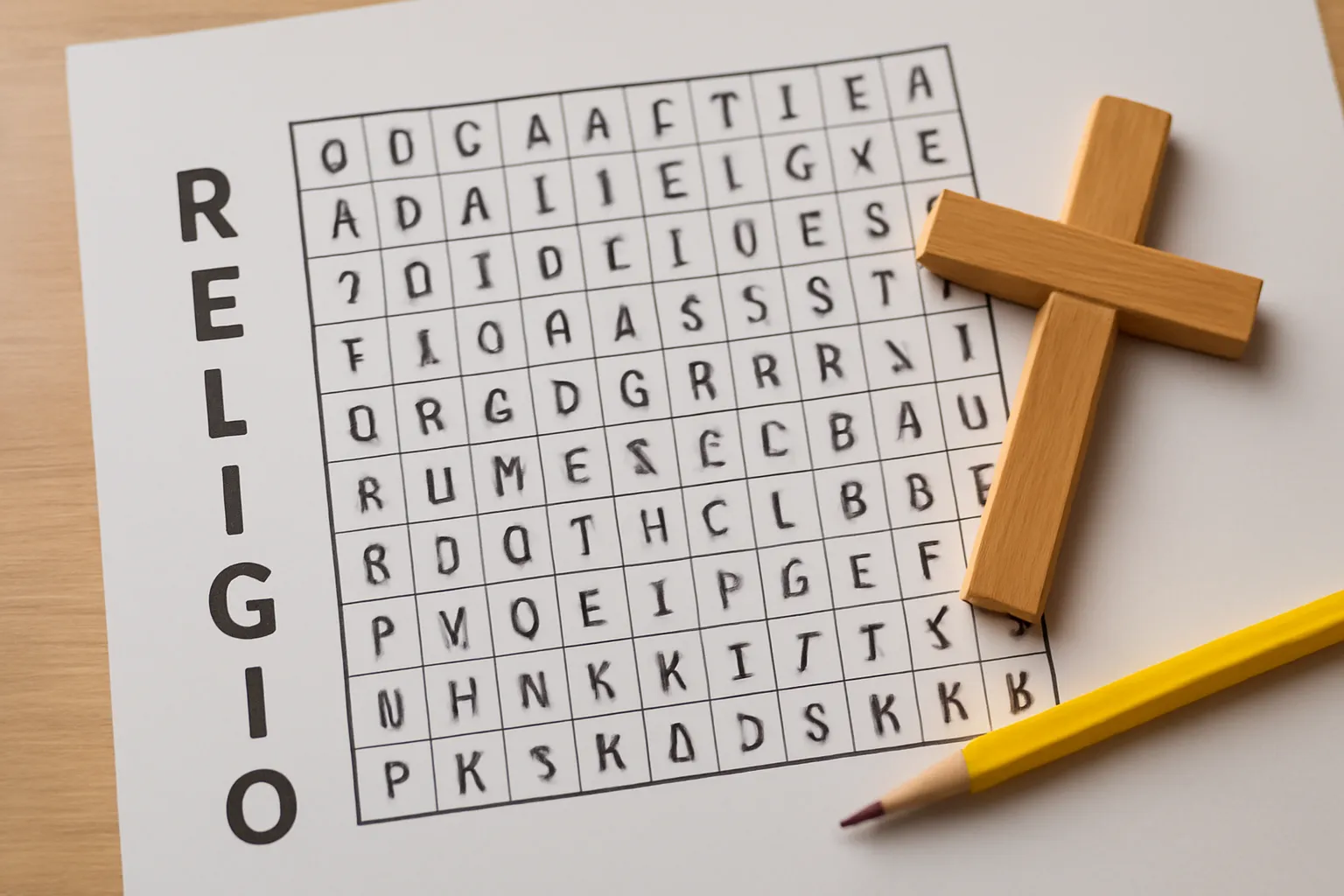
Religious word find puzzles—often called Bible word searches—are a timeless
educational activity that blends literacy skills with spiritual exploration. These puzzles invite solvers
to scan grids of letters in search of biblical terms, names, places, and concepts. For many families,
classrooms, and faith communities, word searches are a welcoming bridge between study and play:
they promote concentration, vocabulary, memory, and biblical literacy in a low-stress and enjoyable
format. The Bible itself becomes a living text to be discovered through patterns,
relationships, and context, rather than a solitary encounter with a single verse.
This article offers a broad overview of religious word find puzzles, with a particular
emphasis on bible word searches for both kids and adults.
You will find explanations of different puzzle formats, practical tips for creating and solving puzzles,
and ideas for integrating these activities into households, classrooms, and faith-based programs.
Word Search Variations for Bible Knowledge
Word searches are not one-size-fits-all. Depending on age, goals, and the spiritual frame you want to emphasize,
you can tailor puzzles to be more playful, more challenging, or more meditative. Below are a range of
variations that keep the core appeal of a word search while expanding its semantic breadth.
Classic Bible Word Search
The classic format uses a grid filled with letters and a list of target words that
appear in the grid in any direction: horizontally, vertically, diagonally, forwards or backwards. This
basic form supports learners at many levels and is ideal for quick activity breaks, evening family time, or
a quick in-class exercise.
Word lists can include people, places, events, and key terms (for example, Adam, Exodus, Messiah).
Grids typically range from 10×10 for younger children to 20×20 for more ambitious solvers.
Solvers are encouraged to use visual scanning strategies, spatial memory, and contextual clues from the bible passage.
Thematic Word Searches
Thematic word searches center on a single biblical theme or a single biblical book.
They are excellent for focused study and for reinforcing key vocabulary related to a topic.
Old Testament themes such as patriarchs, covenants, prophets, or miracles.
New Testament themes such as gospels, parables, apostles, or early church events.
Thematic bundles like fruit of the Spirit (love, joy, peace, patience, kindness, goodness, faithfulness, gentleness, self-control) or Ten Commandments.
Clued or Clue-Driven Word Searches
In a clued word search, the list of terms is paired with concise definitions or clues. Solvers use the clues to confirm that the word they locate is the intended one.
This format adds a level of cognitive engagement and helps with vocabulary building, especially for learners
who benefit from short contextual hints.
Letter Bank Word Finds
A letter bank puzzle presents a grid and a separate bank of letters that must be used (or not used)
to form the target words. The bank may include extra letters to increase difficulty, or it may restrict the
letters to a neat, limited set. This variation emphasizes letter recognition, spelling, and careful placement.
Hidden Message Word Finds
A popular variation is the hidden message puzzle: after you locate all the listed words, the
remaining unused letters reveal a short phrase or verse. This combines the joy of finding words with the
delight of uncovering a new message—often a memory verse or a blessing.
Acrostic and Multi-Block Word Finds
Some designers incorporate acrostics or multi-block layouts where the first letters of each found word
contribute to a cross-word style message. This creates a layered puzzle experience that rewards careful
attention to both individual words and their initial letters.
Today’s digital puzzles can be solved on tablets and computers with interactive features such as
automatically highlighted words, built-in dictionaries, and timer options. Printable formats remain popular
for families and classrooms, with large-print versions for accessibility and color-coded themes to aid younger
solvers.
Bible Word Search for Kids: Engagement and Education
When solving bible word searches with kids, the emphasis often shifts toward
accessibility, readability, and immediate engagement. The right puzzle design can spark curiosity, support
comprehension, and affirm a positive sense of achievement.
Kids-Friendly Design Principles
Use larger fonts and generous line spacing to accommodate developing motor skills and visual acuity.
Choose vocabulary appropriate for age and include familiar biblical names, places, and unit concepts.
Provide optional glossaries or short definitions for tougher terms to build biblical literacy.
Jesus stories and characters (Mary, Nazareth, Bethlehem, manger)
Parables like the Lost Sheep, the Sower, the Mustard Seed
Fruits of the Spirit as both a moral and vocabulary exercise
Cross-Curricular Opportunities
Bible word searches can be integrated with art, music, and storytelling activities.
For example, after solving a new testament puzzle, students might illustrate a scene from a chosen parable or
retell a story in their own words. Such cross-curricular links reinforce comprehension and memory in a holistic way.
Teacher and Parent Tips
Offer starter grids with fewer words for younger children and gradually increase the word count as confidence grows.
Use color-coding to group related terms; e.g., all Old Testament terms in blue and all New Testament terms in green.
Pair each puzzle with a brief discussion prompt or memory verse to deepen reflection.
Bible Word Search for Adults: Challenge, Reflection, and Depth
For adults, word search puzzles can be an engaging way to review familiar material, discover subtle connections,
or refresh knowledge before a study session. The adult brain often benefits from greater challenge,
longer lists, and more thematic complexity. At the same time, these puzzles can be approached as meditative or
devotional practice, depending on the solver’s goals.
Advanced and Thematic Formats for Adults
Complex grids with 20×20 dimensions or larger, requiring persistence and careful strategy.
Multi-book themes that weave terms from multiple biblical books into a single grid, encouraging cross-reference.
Clued word searches with nuanced definitions or allusions to biblical passages, encouraging interpretive thinking.
Hidden message puzzles that encode memory verses, catechesis summaries, or reflective prompts.
Content Areas for Adult Puzzles
Prophets and their key messages, with terms like Elijah, Isaiah, Jeremiah, and repentance.
Apostles and early church leaders, their roles, and major events in Acts and the Epistles.
Miracles and parables—terms connected to healing, teaching, faith, and ethical lessons.
Christian doctrine vocabulary, such as justification, grace, sanctification, and redemption.
Mindful Solving and Reflection
For some adults, a solving session becomes a personal or communal reflection time. Consider pairing puzzles
with a brief devotional reading, a prayer, or a journaling prompt about how a particular term relates to
everyday life. This approach keeps the activity spiritually meaningful while preserving its cognitive benefits.
Practical Tips for Adults
Choose grids with balanced word density so the puzzle is solvable but not trivial.
Offer solution keys or optional hints to support learners who may be rusty on biblical vocabulary.
Incorporate historical or cultural context by including short notes or a companion glossary.
Thematic Word Searches by Book and Theme
A powerful way to structure Bible word searches is around specific biblical books or broad themes. This approach helps solvers see the coherence of the biblical story and the
distinct voices within it.
Exodus terms (Moses, Pharaoh, plagues, Red Sea, covenant at Sinai).
Prophet books such as Isaiah, Jeremiah, Ezekiel, Daniel—focusing on major prophecies and symbols.
New Testament Book-Themed Searches
Gospels (Matthew, Mark, Luke, John) with terms like Christ, disciples, parables, miracles.
Acts and Epistles (early church, Paul, letters, churches, missions).
Revelation with symbols, visions, and themes of hope and judgment (presented in a careful, age-appropriate way).
Themed Bundles and Worship-Cocused Grids
Fruits of the Spirit and ethical virtues as a moral vocabulary map.
Prayer and worship terms (praise, petition, thanksgiving, psalms, altar).
Biblical places (Jerusalem, Bethlehem, Canaan, Zion) to anchor geography in memory.
Seasonal and Liturgical Word Searches
Seasonal puzzles can align with liturgical calendars or family traditions, such as Advent, Christmas, Lent, and Easter. These grids can feature themes like
nativity scenes, resurrection vocabulary, and devotional language.
Creating Your Own Bible Word Searches: Tools and Tips
If you enjoy crafting puzzles as much as solving them, you can design custom Bible word searches
for your group, classroom, or family. The process is approachable, and many free or low-cost tools exist to
assist with word lists, grid generation, and printable formats.
Step-by-Step Creation Guide
Choose a theme that aligns with your educational or devotional aim.
Examples include Patriarchs, Miracles of Jesus, or Ten Commandments.
Compile a word list of target terms associated with the theme. Include a mix of easy and
challenging words to accommodate diverse learners.
Decide on grid size based on the expected audience. Younger solvers may benefit from 8×8 or 10×10 grids;
older solvers may enjoy 12×12 to 20×20 grids.
Place the words in the grid in various directions (horizontal, vertical, diagonal, and backwards)
to create a natural puzzle flow. Avoid forcing every word into a straight line if it hinders readability.
Fill the remaining cells with random letters or with letters that subtly reinforce spelling
patterns relevant to the words (while avoiding obvious duplicates that reveal the answers too quickly).
Create an answer key to help teachers, parents, or group leaders verify solutions or provide hints.
Practical Tools and Techniques
Online puzzle generators and editors can automate grid creation and word placement. Look for tools labeled Bible-friendly or religious puzzle maker if you want curated word lists and safe content.
Spreadsheet-based approaches allow you to design custom grids with precise control over up/down/left/right placements.
Printable templates and clip-art backgrounds can make puzzles visually engaging for children and families.
Quality and Sensitivity Considerations
When designing puzzles that relate to sacred texts, it’s important to respect the beliefs and practices of
diverse readers. Aim for accuracy in terminology, avoid sensational or inappropriate depictions, and provide
context where needed. Offer options for alternative texts or paraphrased terms to accommodate
varying levels of familiarity with scripture.
Educational Outcomes: Benefits of Bible Word Searches
Engaging with bible word searches yields a wide range of educational and spiritual benefits.
Whether used in a family setting or a formal classroom, these puzzles contribute to both cognitive development
and spiritual growth.
Vocabulary expansion in biblical terms, place names, and key people, which supports reading comprehension.
Pattern recognition and spatial awareness, useful in both language arts and logical thinking.
Memory reinforcement through repeated exposure to familiar stories, characters, and verses.
Contextual understanding by connecting terms to broader biblical narratives.
Meditative or devotional value when solved alongside a brief reflection or prayer.
Family and classroom bonding through shared problem-solving experiences and collaborative discussions.
Measuring Impact
Educators and parents can gauge impact through simple observations: Are learners recognizing terms faster?
Do they begin to connect vocabulary with biblical stories? Are they able to articulate a short reflection based on the
theme after solving? Collecting quick feedback or keeping a small puzzle journal can help track growth over time.
Accessibility and Inclusivity: Adapting Puzzles for Diverse Learners
A thoughtful approach to accessibility ensures that bible word searches are inclusive and enjoyable
for people with different abilities and backgrounds. This includes considerations for visual, cognitive, and
language diversity.
Visual Accessibility
Offer high-contrast grids with dark letters on light backgrounds and larger font size when printed.
Provide audio or spoken-word versions of puzzle directions for those using assistive technologies.
Use color-coding but include pattern-based cues (e.g., shapes or borders) in addition to color to aid color-blind solvers.
Cognitive and Language Considerations
Provide glossaries or definitions for unfamiliar terms to support vocabulary-building.
Offer short clue hints or a step-by-step solving guide for learners who benefit from structured prompts.
Include alternate language options or bilingual versions where possible to support English learners and multilingual families.
Accessibility in Practice
In practice, an accessible Bible word search might include a large-print printable version, an audio
companion, and a version with simplified vocabulary for younger students or for readers new to biblical
terminology. Encourage learners to modify the puzzle format to suit their strengths while preserving the
educational intent.
Sample Mini-Puzzle: A Demonstration
Below is a small, illustrative example to show how a theme-based word search might look.
This section is presented for demonstration purposes and is not a complete classroom resource. The grid
is intentionally concise to fit within this article.
R I N E T A L F
A D A M B A B K
V O W E G E S U
E L E L A M R A
N I C T I I F R
D R A B E A M L
I G L A E I T N
S T H E E D A M
Word list for this tiny grid (sample, not exhaustive): Adam, Exodus, Lamb, Faith, Israel, Salvation.
Note how the diagonal and backwards placements increase the challenge while
keeping the activity accessible for older children or curious adults.
This miniature example demonstrates how a themed puzzle can be constructed and solved. In real settings, you would
use a larger grid, a carefully curated word list, and a matching answer key to guide instructors or parents.
Implementation Ideas: Integrating Word Searches into Programs and Families
If you are planning to use Bible word searches regularly, consider building a simple library of puzzles and a
reusable workflow. The following ideas help maximize engagement and learning outcomes.
Family rotation: design a weekly puzzle with a shared theme (e.g., a different book each week). Family members rotate solving duties or read-aloud a brief verse related to the theme after solving.
Classroom snippet: use a 5–10 minute puzzle as a warm-up or assessment probe to gauge students’ prior knowledge of a theme.
Group challenge: teams compete to find the words fastest, with a short debrief to discuss the meaning of the terms.
Reflective extension: after solving, invite solvers to select one term and write a short reflection or a prayer related to it.
Provide both color-coded and monochrome versions to suit different printing capabilities.
Offer a glossary and an answer key for educators and parents who want to review vocabulary with learners.
Include a teacher’s guide with suggested discussion prompts, memory verses, and cross-curricular ideas.
Conclusion: Embracing the Educational and Spiritual Power of Bible Word Searches
Religious word find puzzles represent more than a pastime; they are a bridge between literacy,
memory, and spiritual growth. Whether approached as a playful activity for kids or a challenging
study tool for adults, Bible word searches invite readers to explore biblical language in a
multi-sensory way. By varying formats—from classic grids to clued word searches, letter bank challenges, and hidden message puzzles—educators and families can
tailor experiences to different ages, learning styles, and faith traditions.
The journey through words can mirror the journey through scripture: step by step, pattern by pattern, and
word by word. As you build or solve these puzzles, you may find that the text reveals itself not just as
a collection of stories, but as a living language communicating values, history, and hope. May your puzzles
be a source of joy, learning, and thoughtful reflection for all who encounter them.
Bible Verse Game: 15 Engaging Ways to Learn Scripture and Have Fun In today’s classroom, family room, or small-group setting, a bible verse game can be a powerful companion to traditional study. When scripture is paired with play, memory deepens, context comes alive, and learners of all ages participate with...
Youth Church Service Ideas: Creative Worship and Activities for Teens Teenagers bring energy, curiosity, and fresh perspectives that can transform a church gathering into a dynamic, living faith experience. This article offers a broad spectrum of youth church service ideas designed to engage teens through worship, storytelling, service, and leadership...