Revelation Chapter 1: Analysis, Key Verses and Catholic Reflection
Revelation, the last book of the New Testament, presents a vision given to John through an angel. In Rev 1, the divine message is introduced as a revelation in which Christ speaks to his Church across time. The prologue organizes apocalyptic imagery with a pastoral welcome to seven communities in Asia Minor, while pointing to the triumph of Christ over sin and death. For Catholics, this chapter anchors the book’s dual themes of judgment and mercy, while inviting steadfast faith, worship, and fidelity to the apostolic witness. It also invites readers to discern how prophecy applies to their daily lives.
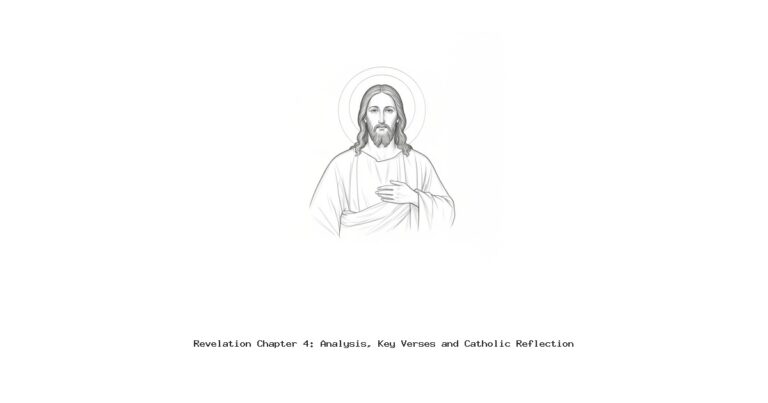
Rev 1 opens with a greeting to John and the seven churches, and proceeds to a vision of the risen Christ who speaks from heaven. The speaker is Christ, presented as the ‘one who is, who was, and who is to come’ and as the Alpha and Omega. The scene unfolds on Patmos, where John is in exile, and the revelation begins with a blessing on readers and listeners and a call to heed what is written. This prologue sets the stage for the seven letters, and it frames the entire book as a revelation intended for endurance and faithfulness.
Key Verses of Rev 1
Rev 1:3 — Blessed is the one who reads aloud
Blessed is the one who reads aloud the words of this prophecy
In Catholic interpretation, this blessing links attentive reading with obedience. It signals that Christian hearing and practice are intimately connected to God’s plan for salvation. It also invites readers to persevere in faith as they live out the prophecy in daily life.
This address locates the message in a concrete historical situation while signaling its universal, apostolic reach. It underscores the church’s vocation in time and space, with Asia Minor as a focal point and the wider Church as its horizon. It also frames the subsequent letters as pastoral exhortations to real communities.
Rev 1:5 — and from Jesus Christ
and from Jesus Christ
This opening phrase places the revelation in the person of Christ, the faithful witness and ruler. It anchors the entire book in Christology, reminding readers that the visions testify to Jesus’ victory and lordship. The phrase also emphasizes that prophecy flows from the risen Christ who shepherds his church.
Rev 1:8 — I am the Alpha and the Omega
I am the Alpha and the Omega
This title proclaims Christ’s eternal sovereignty and universality. It frames history as governed by the divine Logos who begins and completes all things. It invites trust that God’s plan for creation culminates in the triumph of Christ and the Spirit.
Rev 1:11 — Write on a scroll what you see
Write on a scroll what you see
John’s vision is entrusted to written form, signaling the authoritative transmission of revelation. The term scroll evokes prophetic and apostolic authority to shepherd the Church. It also foreshadows the detailed, multi-sensory visions that follow in the book.
Rev 1:17 — When I saw him
When I saw him, I fell at his feet as though dead
This moment expresses the overwhelming majesty of the glorified Christ and John’s response of reverent awe. It reveals the intimate humanity of a beloved disciple in the presence of the divine. It also introduces the divine consolations and commissioning that follow in the vision.
Patristic writers such as Irenaeus, Origen, and Augustine read Revelation as a Christ-centered revelation that discloses the victory of God and the Church through conflict. The Magisterium follows a two-sense approach (literal and spiritual) emphasized in Dei Verbum and the Catechism, interpreting the imagery as symbolic language that points to real realities in Christ. The Church’s teachings stress fidelity to the apostolic witness, perseverance in faith, and proper discernment of eschatological symbolism within the tradition of sacred Scripture and sacred tradition.
This Chapter in the Liturgy
In the Roman Rite, Revelation is not a fixed, recurring Sunday reading; it appears more often in the Liturgy of the Hours and in catechetical contexts. It is sometimes drawn into liturgical celebrations that emphasize Christ’s kingship, the heavenly realities announced in the book, or the apostolic witness of John. Across regions, teachers and lectors may reference Rev 1 to illuminate fidelity under trial and the hope of divine victory.
Lectio Divina
Verse for meditation: Blessed is the one who reads aloud the words of this prophecy.
Meditation question: How can I read this prophecy today in a way that shapes my daily obedience and hope in Christ?
Prayer: Lord Jesus, open my ears to your Word and help me keep it with faith, hope, and love.
FAQ
Who is the author of the book of Revelation and what is his relation to Rev 1? Answer: The author identifies himself as John, traditionally understood as John the Apostle, who records the visions and messages for the Church.
Why does Revelation use symbols and visions rather than straightforward prose? Answer: The apocalyptic genre conveys truth through symbolic imagery to encourage perseverance and hope amid persecution, while inviting discernment within the Church’s interpretive tradition.
How does Rev 1 relate to Catholic doctrine on end times? Answer: Rev 1 presents Christ’s victory, the unity of creation, and the Church’s mission—perspective that informs Catholic eschatology without predicting precise chronological events.
How should Rev 1 be read in prayer and study today? Answer: In light of Dei Verbum and the Catechism, read with the Church, within tradition, seeking both the literal meaning and its spiritual significance for faith and action.
Catholic NABRE study of Revelation 4: overview, paraphrased key verses, church teaching, liturgical use, Lectio Divina steps, and practical FAQs for reflection.
An in-depth Catholic study of Revelation 5 in NABRE, including text context, key verses with brief NABRE quotes, Church teaching, liturgical relevance, Lectio Divina, and practical reflections.